How many days in Busan? 3 days of beaches, temples and fish markets
By Tony Panopoulos · travel-agency planner in Greece · Updated
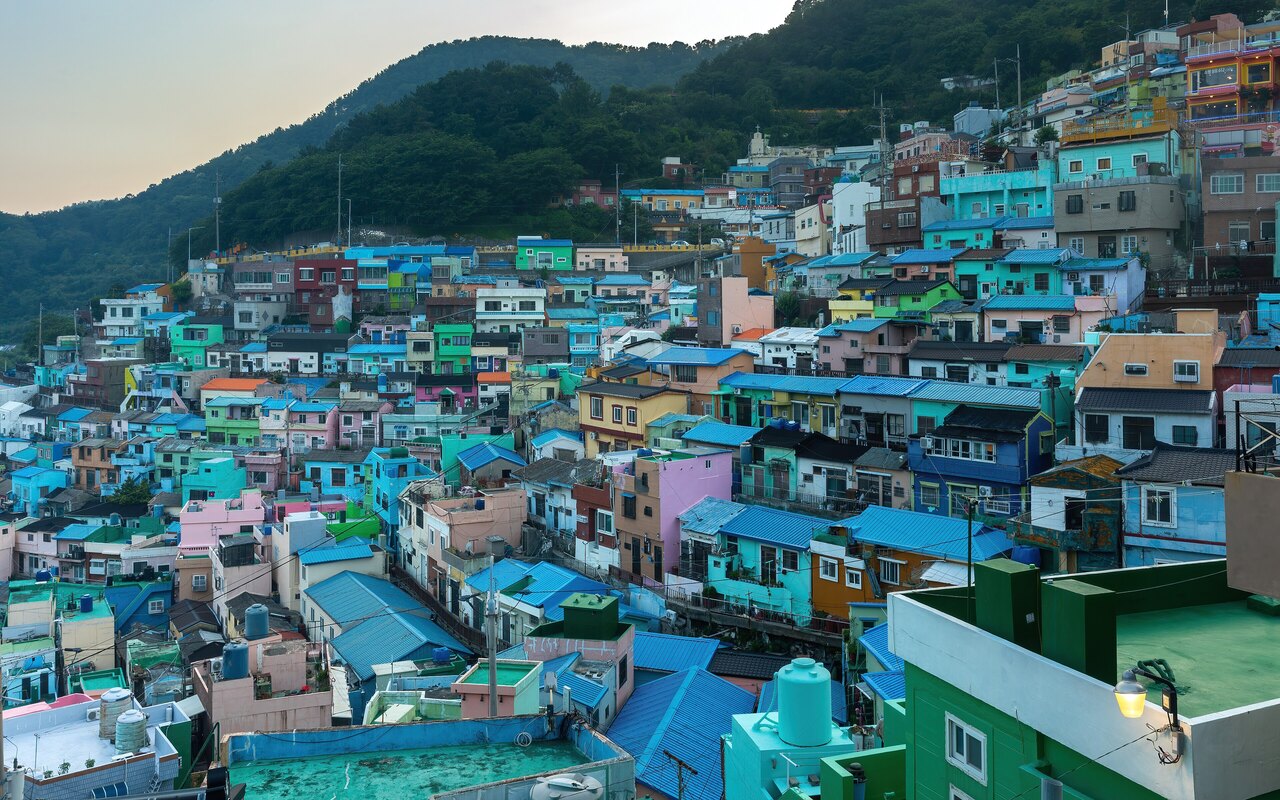
Busan is South Korea's second city and its biggest port, strung along 40 km of coast between mountains and sea. Give it three days and split it by side of town: the east for Haeundae beach and the seaside temple, the old port around Nampo for markets and Gamcheon's painted hillside, and the south coast for cliffs at Taejongdae. The KTX from Seoul takes about 2.5 hours, so it fits easily into a Korea trip.
Short answer
Two days covers Haeundae, the temple, Gamcheon and Jagalchi at speed. The third day adds the cliffs of Taejongdae, Beomeosa temple in the mountains and an evening under the lit Gwangan Bridge.
The 3-day plan, day by day
Day 1: Haeundae, Blueline Park and the sea temple
Morning. Take a bus or taxi (about 30-40 minutes from Haeundae) to Haedong Yonggungsa, a Buddhist temple built on rocks over the sea, free and open from about 5:00. Arrive before 9:00 to beat tour groups on the 108 steps.
Afternoon. Back at Haeundae, ride the Blueline Park sky capsule, a small pod on an elevated track along the cliffs to Cheongsapo (about ₩35,000-45,000 per capsule for two, book online). Walk back via the Cheongsapo Daritdol skywalk and the 2 km Haeundae beach.
Evening. Walk around Dongbaekseom island (30 minutes) for night views of the Marine City towers. Then eat grilled clams (jogaegui) at the tents of Cheongsapo, roughly ₩40,000-60,000 for two.
Blueline Park capsules sell out at sunset on weekends; book 3-5 days ahead on the official site.
Day 2: Gamcheon, Jagalchi and Nampo
Morning. Take metro line 1 to Toseong and a short bus or taxi uphill to Gamcheon Culture Village, once a refugee settlement from the Korean War and now painted lanes of art installations. Buy the stamp map (about ₩2,000) and follow the route for 1.5-2 hours.
Afternoon. Head down to Jagalchi Fish Market, Korea's largest: choose live fish or king crab downstairs and have it prepared upstairs (from about ₩40,000 for two). Then walk the stalls of Gukje Market and BIFF Square, where you queue for ssiat hotteok, seed-filled pancakes at ₩2,000.
Evening. Take the escalators up Yongdusan Park to Busan Tower (about ₩12,000). The night view takes in the port and the Busan Harbour Bridge.
Gamcheon is steep; wear trainers and do the route downhill, starting from the top bus stop.
Day 3: Taejongdae, Songdo and Gwangalli
Morning. Bus from Nampo (about 25 minutes) to Taejongdae, a forested headland with cliffs and a lighthouse. The Danubi road train loops the park (about ₩4,000), or walk the 4 km road in 1.5 hours.
Afternoon. Visit Huinnyeoul Culture Village, white houses on the cliffs of Yeongdo with a coastal path. Then cross to Songdo and ride the Songdo Bay Cable Car over the sea (about ₩17,000-22,000; the crystal floor costs more).
Evening. End at Gwangalli beach, where the 7.4 km Gwangan Bridge lights up after dark. Eat raw fish (hoe) at the Millak raw fish centre and watch the Saturday drone show if it is scheduled.
On a rainy day, swap the cliffs for Shinsegae Spa Land in Centum City, a large jjimjilbang spa of about ₩20,000-25,000.
Only have 2 days?
With 2 days, do Day 1 and Day 2 and put Gwangalli in the evening of Day 1, 15 minutes by metro from Haeundae. You lose Taejongdae and the Songdo cable car.
Got extra days?
A 4th day can go to Beomeosa, a 7th-century mountain temple at the end of metro line 1, with a hike up Geumjeongsan; or take the train 1 hour to Gyeongju, the ancient Silla capital with royal tombs and Bulguksa temple.
Where to stay in Busan
| Budget | Area | Why | Typical double/night |
|---|---|---|---|
| Budget | Seomyeon | Where metro lines 1 and 2 cross; cheap hotels, nightlife and food alleys. | ₩50,000-90,000 |
| Mid-range | Haeundae | Beachfront, near Blueline Park and the sea temple; the classic base. | ₩120,000-220,000 |
| Mid-range | Nampo / Jung-gu | Walking distance to Jagalchi, Gukje Market and Busan Tower, 15 minutes from Busan Station. | ₩80,000-150,000 |
| Comfort | Haeundae / Marine City sea-view hotels | High floors over the beach and Gwangan Bridge, with spas and pools. | ₩300,000-600,000 |
Getting around
Busan has four metro lines plus the Donghae line to the east coast; fares are about ₩1,500-1,800 with a T-money card, which also pays for buses and taxis. Haeundae to Nampo takes about 50 minutes on line 2 and line 1. Gimhae airport is 30-40 minutes from Seomyeon by light rail and metro, or about ₩30,000 by taxi. KTX trains from Seoul arrive at Busan Station in about 2.5 hours for roughly ₩60,000. Taxis start at about ₩4,800 and use the Kakao T app. City buses are useful for the coast: bus 1001 and 1003 run along the shore, and the City Tour Bus (about ₩20,000 a day) hops between Haeundae, Taejongdae and Nampo. Naver Map works far better than Google Maps for walking directions in Korea.
What to eat in Busan
Busan is a seafood city. At Jagalchi and the Millak centre, choose live fish to be sliced as hoe. The local soup is dwaeji gukbap, pork and rice broth at ₩9,000-11,000, best on Seomyeon's gukbap alley. Try milmyeon, cold wheat noodles invented by war refugees, and eomuk (fish cakes) from the Samjin Eomuk shop near Busan Station. Street food at BIFF Square includes ssiat hotteok. Pair grilled clams with C1 soju, the local brand. Dinner rarely starts before 18:30 and many restaurants serve dishes for a minimum of two people. For cheap late snacks, the Bupyeong Kkangtong night market near Gukje Market opens around 19:30 with tteokbokki, eomuk and grilled skewers at ₩3,000-6,000, and convenience stores sell kimbap rolls for about ₩3,000. Water and side dishes (banchan) are free and refilled without asking.
Best time to visit
May to June and September to October, with highs of 20-26°C and clear skies. July and August are hot and humid (around 30°C) and the beaches are full; the rainy season runs late June to July and typhoons can hit in August-September. October brings the Busan International Film Festival and the fireworks festival over Gwangalli, when hotels fill.
Month-by-month weather for Busan →
What a day costs
| Budget | Mid-range | Comfort | |
|---|---|---|---|
| Bed (per person, sharing a double) | ₩35,000 | ₩85,000 | ₩200,000 |
| Food & drink | ₩30,000 | ₩60,000 | ₩120,000 |
| Sights & tickets | ₩10,000 | ₩35,000 | ₩60,000 |
| Local transport | ₩7,000 | ₩15,000 | ₩40,000 |
| Total per person, per day | about ₩82,000 | about ₩195,000 | about ₩420,000 |
Approximate 2026 prices in South Korean won; there is no city tourist tax, and VAT is included in shop and restaurant prices.
Before you go
Common questions
Is Busan worth it if I only have a week in Korea?
Yes. With 7 days, give Seoul 4 days and Busan 2-3 days. The KTX takes about 2.5 hours, and you can stop at Gyeongju on the way. Busan feels very different from Seoul: sea air, beaches, seafood and steep hillside neighbourhoods.
Which is better as a base, Haeundae or Seomyeon?
Haeundae if you want the beach and the east coast sights; Seomyeon if you want central transport and nightlife, with both main metro lines. Nampo suits a short stay focused on markets and Gamcheon. All three are within 40 minutes of each other by metro.
Can I swim at Haeundae?
Officially from about June to mid-September, when lifeguards are on duty and the beach is marked out with swimming zones; outside the season, swimming is discouraged. In August the beach can be crowded with umbrellas. Gwangalli and Songjeong beaches are calmer.
Do I need a K-ETA to visit?
Many nationalities that can visit Korea without a visa need a K-ETA online authorisation, though some have been temporarily exempted until the end of 2026. Check the official K-ETA site before booking, and apply at least 72 hours before departure if required.
How this guide was made
Compiled by TonyPlan from official tourism, transport and attraction sources and on-the-ground travel knowledge. Prices are approximate for 2026 and change with season; anything we could not confirm is marked as approximate.
Some links on this page are partner links. If you book through them TonyPlan may earn a commission; the price you pay is the same. How we make money.