How many days in Oman? 7 days: Muscat, wadis, turtles, dunes and mountain forts
By Tony Panopoulos · travel-agency planner in Greece · Updated
Oman is the easiest country in the Gulf to explore by car: good roads, cheap fuel, little traffic and a loop of sights within 2-3 hours of each other. Seven days covers the classic circuit: two days in Muscat, then south along the coast to the swimming wadis and the turtle beach at Ras al Jinz, inland to a desert camp in the Wahiba Sands, and back through Nizwa and the Hajar Mountains. Visit in the cool months, from October to March.
Short answer
Five days covers Muscat, Wadi Shab, a desert night and Nizwa at a fast pace. Seven lets you add the turtles of Ras al Jinz and a full mountain day.
The 7-day plan, day by day
Day 1: Muscat: Grand Mosque and Mutrah
Morning. Visit the Sultan Qaboos Grand Mosque (free; non-Muslim visitors from about 8:00 to 11:00, Saturday to Thursday). Its prayer hall has one of the world's largest hand-woven carpets and a 14 m Swarovski crystal chandelier. Women must cover hair, arms and legs; men need long trousers.
Afternoon. Rest through the midday heat, then walk the Mutrah Corniche, with dhows in the harbour and the Mutrah Fort above it. Enter the Mutrah Souq from the waterfront for frankincense, silver and pashminas.
Evening. Eat Omani or Indian food in Mutrah: mashuai, biryani or grilled fish, about OMR 3-8, with fresh lime-mint juice.
Haggling is expected in the souq but polite; start at about two-thirds of the first price.
Day 2: Old Muscat and the Royal Opera House
Morning. Drive to Old Muscat and see the blue-and-gold facade of Al Alam Palace from the gate, between the Portuguese forts of Al Jalali and Al Mirani. Visit the National Museum (about OMR 5) and Bait Al Zubair for Omani history, weapons and costume.
Afternoon. Tour the Royal Opera House Muscat (about OMR 3-5 for a guided visit), built in white stone and Omani wood, then swim at Qurum Beach.
Evening. Take a sunset dhow cruise along the coast (about OMR 15-25), or book a dolphin trip for an early morning.
Rent your car on Day 3 rather than Day 1: Muscat taxis and ride-hailing (OTaxi) are fine for the city.
Day 3: Bimmah Sinkhole, Wadi Shab and Ras al Jinz
Morning. Drive the coastal highway south. Stop at the Bimmah Sinkhole (free), a turquoise pool in a limestone crater, then reach Wadi Shab (about 1h45 from Muscat). Cross by small boat (about OMR 1 return), then hike 45-60 minutes to the pools and swim to a cave with a waterfall.
Afternoon. Continue to Sur, the old seafaring town where dhows are still built by hand, and on to Ras al Hadd.
Evening. Join a guided night tour at the Ras al Jinz Turtle Reserve (about OMR 7-10) to watch green turtles nest on the beach, most of the year.
Carry swimwear that covers shoulders and knees for the wadis, a waterproof bag and water shoes.
Day 4: Wadi Bani Khalid and the Wahiba Sands
Morning. Drive about 2 hours inland to Wadi Bani Khalid, with green pools under palms, a short walk from the car park; good for a swim.
Afternoon. Continue to Al Wasil or Bidiyah, the gateways to the Wahiba (Sharqiya) Sands, where dunes reach 100 m. Camps send 4x4s to pick you up, or you drive in on deflated tyres.
Evening. Watch sunset from a dune, eat dinner at the camp (stays OMR 40-120 per room with half board) and sleep under clear desert skies.
Do not drive into the dunes in a normal car; even a 4x4 needs tyres deflated and some experience.
Day 5: To Nizwa: fort and souq
Morning. Drive about 2.5 hours west to Nizwa, the old inland capital. Climb the round tower of Nizwa Fort (about OMR 5), built in the 17th century, for views over the palm groves.
Afternoon. Explore the Nizwa Souq, with halls for dates, spices, pottery, silver khanjars (curved daggers) and halwa, the Omani sweet.
Evening. Stay in Nizwa or at Birkat al Mouz, a village with old mud houses and an aflaj (irrigation channel) at the foot of the mountains.
On Friday mornings from about 7:00, the Nizwa goat market auctions livestock in a ring next to the fort.
Day 6: Jebel Akhdar or Jebel Shams
Morning. Drive up Jebel Akhdar, the 'Green Mountain', where the police checkpoint at the foot of the road admits 4x4 vehicles only. Walk the village path between Al Ayn, Al Aqr and Wadi Bani Habib past terraced rose gardens, pomegranates and walnuts.
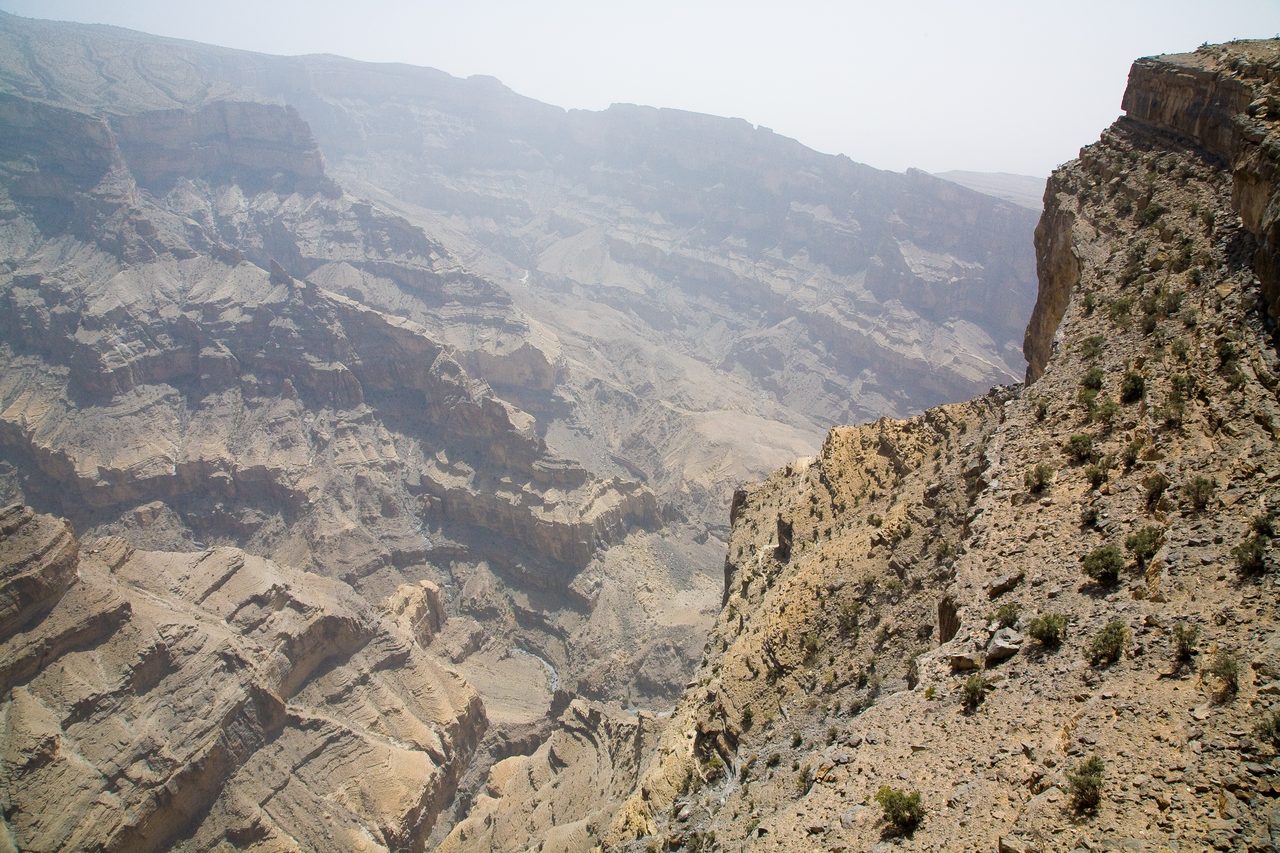
Afternoon. Or drive to Jebel Shams, Oman's highest mountain at about 3,000 m, for the Balcony Walk along the rim of Wadi Ghul, the 'Grand Canyon of Arabia', about 3 hours return. On the way, stop at the hanging village of Misfat al Abriyeen.
Evening. See Bahla Fort, a UNESCO site, and Jabrin Castle (about OMR 3 each) on the way back to Nizwa.
Mountain nights are cold in winter; bring a warm layer.
Day 7: Back to Muscat
Morning. Drive about 1h45 back to Muscat. Stop at the old village of Al Hamra on the way if you have time.
Afternoon. Shop at the Mutrah Souq for frankincense and dates, or swim at Al Bustan beach.
Evening. A last dinner of Omani food in Muscat, then fly home.
Muscat airport is about 30-40 minutes from Mutrah; leave at least 2 hours before an international flight.
Only have 5 days?
With 5 days, do Muscat in one day, then Wadi Shab, a desert night and Nizwa, returning to Muscat on Day 5. Skip Ras al Jinz and the mountains.
Got extra days?
Add Musandam, the fjords of the far north, for a dhow cruise, or Salalah in the south during the khareef monsoon (July to September), when the hills turn green.
Where to stay in Oman
| Budget | Area | Why | Typical double/night |
|---|---|---|---|
| Budget | Mutrah / Ruwi (Muscat) | Simple hotels near the souq and the corniche. | OMR 20-35 |
| Mid-range | Qurum / Al Khuwair (Muscat) | Modern hotels near the beach, malls and restaurants. | OMR 40-80 |
| Mid-range | Nizwa / Wahiba camps | Heritage guesthouses and desert camps with half board. | OMR 40-120 |
| Comfort | Al Bustan / Jebel Akhdar resorts | Beach and mountain resorts with views. | OMR 150-400 |
Getting around
A rental car (about OMR 15-30 a day; 4x4 OMR 35-60) is the way to see Oman; fuel costs about OMR 0.25 a litre. Main roads are excellent and signposted in English. Mwasalat buses link Muscat with Sur and Nizwa but not the wadis or desert. In Muscat, use taxis or OTaxi.
What to eat in Oman
Omani food is mild and spiced with cardamom, saffron and dried lime. Shuwa is lamb marinated and cooked slowly in an underground pit for festivals. Try majboos, mashuai (grilled kingfish with rice), and Omani halwa with kahwa, cardamom coffee, served with dates as a welcome. Indian and Pakistani restaurants are everywhere and cheap, OMR 2-5 a meal. Alcohol is served only in licensed hotels and some restaurants.
Best time to visit
October to March: 25-30°C by day and cool nights in the desert and mountains. April to September is extremely hot (often above 40°C). Ramadan changes opening hours; eating in public during the day is not allowed.
Month-by-month weather for Oman →
What a day costs
| Budget | Mid-range | Comfort | |
|---|---|---|---|
| Bed (per person, sharing a double) | OMR 15 | OMR 35 | OMR 100 |
| Food & drink | OMR 8 | OMR 18 | OMR 40 |
| Sights & tickets | OMR 5 | OMR 12 | OMR 30 |
| Local transport | OMR 10 | OMR 15 | OMR 30 |
| Total per person, per day | about OMR 38 | about OMR 80 | about OMR 200 |
Approximate 2026 prices in Omani rials (about OMR 0.385 to US$1), with transport based on a shared rental car. Hotels add about 4% municipality tax plus VAT and service charges.
Before you go
Common questions
Do I need a visa for Oman?
Many nationalities, including most European and North American passports, can enter visa-free for up to 14 days for tourism. Others apply online for an eVisa on the Royal Oman Police site. Rules change, so check the official site before travel, and make sure your passport is valid for six months.
Is Oman safe?
Yes, it is one of the safest countries in the region, with low crime and a welcoming attitude to visitors. The main risks are road accidents, flash floods in wadis after rain, and heat. Dress modestly in towns and villages, covering shoulders and knees, and ask before photographing people.
Do I need a 4x4?
Not for the main roads, Muscat, Wadi Shab, Nizwa or Jebel Shams, where a normal car is fine. You need a 4x4 to drive up Jebel Akhdar (police check at the bottom) and into the Wahiba Sands, although most camps will collect you from the edge of the desert.
Can I swim in the wadis?
Yes. Wadi Shab and Wadi Bani Khalid have clear pools. Wear swimwear that covers shoulders and knees, take your rubbish with you, and never visit after heavy rain, when flash floods can arrive with little warning. Lifeguards are rare, so swim within your ability.
How this guide was made
Compiled by TonyPlan from official tourism, transport and attraction sources and on-the-ground travel knowledge. Prices are approximate for 2026 and change with season; anything we could not confirm is marked as approximate.
Some links on this page are partner links. If you book through them TonyPlan may earn a commission; the price you pay is the same. How we make money.