Home › Namibia › How many days
How many days in Namibia? 10 days, a self-drive loop from Sossusvlei to Etosha
By Tony Panopoulos · travel-agency planner in Greece · Updated
Namibia is twice the size of Germany with fewer than three million people, and most of it is desert. It is one of the easiest countries in Africa to explore by self-drive: good gravel roads, clear signposting and lodges spaced a day's drive apart. Give it ten days for the classic loop from Windhoek: the dunes of Sossusvlei, the Atlantic town of Swakopmund, the granite and rock art of Damaraland, and Etosha National Park, where elephants, lions and rhinos come to floodlit waterholes. Expect 4-6 hours of driving on transfer days.
Short answer
Seven days covers Sossusvlei (two nights), Swakopmund and Etosha (two nights), skipping Damaraland. Ten days is the comfortable minimum for the full loop without driving every day.
The 10-day plan, day by day
Day 1: Windhoek
Morning. Land at Hosea Kutako International Airport, about 45 km east of Windhoek, and collect a 4x4 or high-clearance car. Check the two spare tyres, jack and tools before you sign.
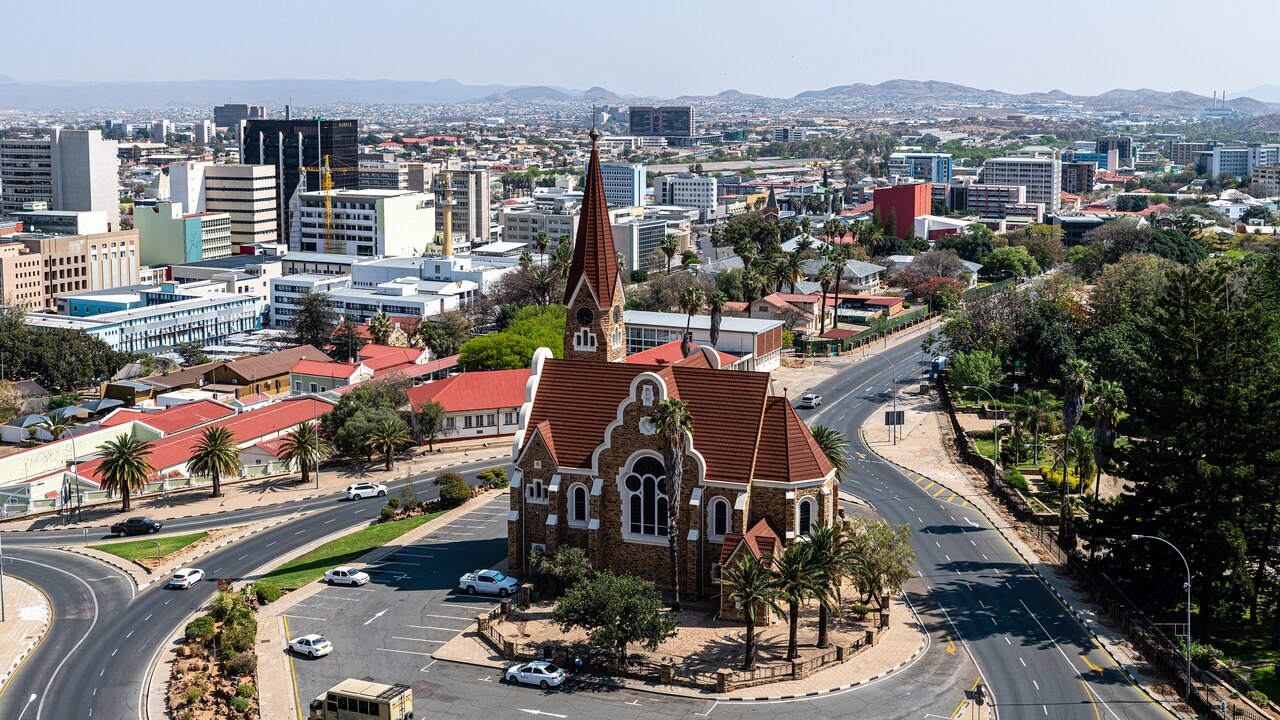
Afternoon. See the Christuskirche, the German Lutheran church of 1910, and the Independence Memorial Museum (free), then buy supplies, water and a local SIM card.
Evening. Eat game meat, from oryx to kudu, at Joe's Beerhouse, a Windhoek institution; a main costs about N$200-300.
Many nationalities now need a visa for Namibia; apply online before travel or check whether visa on arrival applies to you.
Day 2: Drive to Sossusvlei
Morning. Drive about 5 hours south-west to Sesriem, crossing the Spreetshoogte or Remhoogte pass down the escarpment, mostly on gravel.
Afternoon. Check in near the Sesriem gate and walk into Sesriem Canyon, a narrow gorge up to 30 metres deep, carved by the Tsauchab river.
Evening. Watch the sunset light on the dunes from Elim Dune, 5 km from the gate, then dinner and stars at your lodge.
Only guests at lodges and camps inside the park gate can enter about an hour before sunrise; others wait for the gate to open at sunrise.
Day 3: Deadvlei and Big Daddy
Morning. Enter at first light (park fee about N$150 per person plus a vehicle fee) and drive 60 km to Dune 45, climbing it for sunrise. Continue to the 2x4 car park and take the shuttle (about N$200) over the last 5 km of sand to Deadvlei, a white clay pan of dead camel thorn trees about 600-900 years old.
Afternoon. Fit walkers can climb Big Daddy, one of the highest dunes at about 325 metres, in 1.5-2 hours, then run straight down into Deadvlei. Leave by 12:00, when the sand can reach 60°C.
Evening. Rest at the lodge; take a scenic flight or quad-bike ride if the budget allows.
Carry at least 2 litres of water per person and a hat; there is no shade in the vleis.
Day 4: To Swakopmund via Solitaire
Morning. Drive north on the C19 and C14 to Solitaire, a desert hamlet with fuel and famous apple crumble, then past the Tropic of Capricorn sign and through the Gaub and Kuiseb canyons. The full drive takes 5-6 hours.
Afternoon. Reach Walvis Bay, where flamingos feed in the lagoon, then drive 30 minutes up the coast to Swakopmund.
Evening. Walk the German-era centre to the Mole and the jetty, and eat fresh oysters and fish; Walvis Bay oysters cost about N$25-40 each.
The coast is cool and often foggy: 15-20°C even in summer. Pack a fleece.
Day 5: Swakopmund: Sandwich Harbour or the Living Desert
Morning. Take a 4x4 tour to Sandwich Harbour, where dunes drop straight into the Atlantic (about N$1,800-2,500 with lunch); access depends on the tides. Or join a Living Desert tour to find chameleons, geckos and sidewinder snakes in the dunes.
Afternoon. Join a marine cruise from Walvis Bay to see Cape fur seals, dolphins and pelicans, or try sandboarding on the dunes outside town.
Evening. Have dinner at a seaside restaurant on the Swakopmund jetty.
Do not drive into Sandwich Harbour yourself without experience; vehicles are often lost to the tide.
Day 6: Spitzkoppe and Damaraland
Morning. Drive about 2 hours inland to Spitzkoppe, a 1,728-metre granite peak rising from the plains (community fee about N$100-150). Walk to the Rock Arch and San rock paintings.
Afternoon. Continue 3 hours north to Twyfelfontein area via Uis, through bare red-and-ochre country.
Evening. Stay at a lodge near the Aba-Huab valley and look for desert-adapted elephants in the dry riverbeds.
Fill up in Uis or Khorixas; fuel stations are few in Damaraland.
Day 7: Twyfelfontein and desert elephants
Morning. Walk the Twyfelfontein rock engravings, Namibia's first UNESCO site, with over 2,000 figures carved by hunter-gatherers (about N$100-150, with a mandatory local guide).
Afternoon. Join a lodge drive to track desert-adapted elephants along the Huab or Aba-Huab river (about N$900-1,400), or see the Organ Pipes and Burnt Mountain nearby.
Evening. Dinner and sundowners at the lodge, with clear desert skies.
Visit the Living Museum of the Damara for a short programme on traditional skills, run by the community.
Day 8: Etosha: Okaukuejo
Morning. Drive about 4 hours east via Kamanjab to Etosha's Anderson Gate (park fee about N$150-200 per person per day plus vehicle).
Afternoon. Drive the waterholes west of Okaukuejo, such as Okondeka and Nebrownii, watching elephants, zebras and springbok.
Evening. Sit at the floodlit Okaukuejo waterhole, where black rhinos often drink after dark.
Stay inside the park if you can; gates close at sunset, and camps are the only place you can be after dark.
Day 9: Etosha: Halali and the pan
Morning. Drive at dawn along the edge of the Etosha Pan, a white salt flat about 4,800 square kilometres in size, stopping at waterholes such as Rietfontein.
Afternoon. Rest at Halali camp in the heat, then check the waterholes of Goas and Salvadora for lions.
Evening. Watch the Moringa waterhole at Halali, another floodlit site, for leopard and rhino.
Waterholes are best from June to October, when there is no water elsewhere and the animals gather.
Day 10: Namutoni and back to Windhoek
Morning. Drive east to the old German fort at Namutoni, past the Klein Namutoni and Chudop waterholes, often good for giraffes and lions.
Afternoon. Leave by the Von Lindequist Gate and drive about 5-6 hours south to Windhoek via Otjiwarongo.
Evening. Spend a final night in Windhoek before your flight, or stop at a guest farm near Okahandja, with its woodcarving market.
Drop at least one night at a lodge near the airport if you have an early flight.
Only have 7 days?
With 7 days, skip Damaraland: Windhoek, two nights at Sossusvlei, two in Swakopmund, then drive the long day via the B2 and C33 to two nights in Etosha.
Got extra days?
Extra days go to the Skeleton Coast, Fish River Canyon in the south, the Caprivi Strip with its rivers and hippos, or the Okavango Delta in Botswana, about 1 day's drive from northern Namibia.
Where to stay in Namibia
| Budget | Area | Why | Typical double/night |
|---|---|---|---|
| Budget | Campsites (rooftop tent) inside Etosha and Sesriem | The cheapest way to stay inside the parks, with shared facilities. | N$400-900 |
| Mid-range | Government rest camps (NWR) in Etosha and Sesriem | Simple chalets inside the parks, next to the floodlit waterholes. | N$2,000-4,500 |
| Mid-range | Swakopmund guesthouses / Damaraland lodges | Comfortable family-run stays with dinner, in good locations. | N$1,800-4,000 |
| Comfort | Private lodges at Sossusvlei, Damaraland and Etosha's borders | Full-board lodges with guided activities and views over the desert. | N$6,000-15,000 |
Getting around
Self-drive is best. Rent a 4x4 or high-clearance car with two spare tyres (about N$1,200-2,500 a day, more with a rooftop tent). Most roads are gravel: keep to 80 km/h, slow down for corrugations and drive only in daylight, as animals cross at night. Fuel is available in towns but not between them; fill up at every chance. Namibia drives on the left. If you prefer not to drive, small-group or private guided tours cover the same loop.
What to eat in Namibia
Namibia is a meat country. Try game such as oryx, kudu and springbok, grilled as steaks or in a potjie (stew), and biltong (dried meat) from butchers for snacks on the road. In towns, kapana is street-grilled beef with spice and chilli. German heritage shows in Swakopmund's bakeries, with apple strudel and Black Forest cake, and in Windhoek Lager, brewed to the German purity law. On the coast, eat oysters from Walvis Bay. A lodge dinner costs N$300-500; a restaurant meal in town N$150-300.
Best time to visit
May to October is the dry season and the best time for wildlife, with clear skies, cool nights (sometimes below 0°C in the desert in June-July) and highs of 22-30°C. November to April is hotter (up to 40°C) with afternoon storms, green landscapes, newborn animals and fewer visitors. The coast is cool and foggy year-round. Book lodges in Etosha and Sossusvlei months ahead for July-October.
Month-by-month weather for Namibia →
What a day costs
| Budget | Mid-range | Comfort | |
|---|---|---|---|
| Bed (per person, sharing a double) | N$300 | N$1,500 | N$5,000 |
| Food & drink | N$300 | N$500 | N$800 |
| Sights & tickets | N$200 | N$500 | N$1,200 |
| Local transport | N$800 | N$1,000 | N$1,500 |
| Total per person, per day | about N$1,600 | about N$3,500 | about N$8,500 |
Approximate 2026 prices in Namibian dollars (N$, equal in value to the South African rand, which is also accepted); transport assumes a shared 4x4 rental and fuel, and full-board lodges include most meals.
Before you go
Common questions
Do I need a 4x4 in Namibia?
Not strictly for this loop: the main gravel roads are passable in a sedan in the dry season. But a 4x4 or high-clearance SUV handles corrugations, sand and river crossings better, and you need one to drive the last 5 km to Sossusvlei yourself. Rental companies often restrict where small cars can go. Get full insurance including tyres and windscreen.
Is Namibia safe for self-drive?
Yes, it is one of the safest countries in Africa for independent travel. The main risk is road accidents, especially rollovers on gravel at high speed, and driving at dusk when animals cross. In Windhoek and towns, do not leave valuables in the car, use guarded parking and avoid walking alone at night.
Do I need a visa for Namibia?
Since April 2025, citizens of many countries that previously entered visa-free, including the UK, the US and most of the EU, need a visa. You can apply online for an e-visa or, for eligible nationalities, get one on arrival at the airport for a fee. Check the current list on the official Namibian immigration website before you travel.
Is Etosha good for seeing the Big Five?
Etosha has four of them: elephant, lion, leopard and black rhino, but no buffalo. Its strength is the waterholes: in the dry season you can sit in your car or at a floodlit camp waterhole and watch animals arrive. It is very good for elephants, rhinos and lions, and you can drive yourself, which keeps costs low.
How this guide was made
Compiled by TonyPlan from official tourism, transport and attraction sources and on-the-ground travel knowledge. Prices are approximate for 2026 and change with season; anything we could not confirm is marked as approximate.
Some links on this page are partner links. If you book through them TonyPlan may earn a commission; the price you pay is the same. How we make money.