Home › Medellin › How many days
How many days in Medellin? 4 days by metro and cable car, plus Guatape
By Tony Panopoulos · travel-agency planner in Greece · Updated
Medellin fills a long green valley, the Aburra Valley, at about 1,500 metres, with a spring-like 22-28°C all year. Give it four days: one for the centre and its Botero sculptures, one for Comuna 13 and the cable cars that changed the hillside neighbourhoods, one in the leafy districts of Laureles and El Poblado, and one at the Penol de Guatape, a granite rock with 740 steps above a lake. The clean, cheap metro links almost everything.
Short answer
Three days covers the centre, Comuna 13, the Metrocable and Guatape. The fourth day is for the botanical garden, the memory museum and the city's coffee and nightlife without rushing.
The 4-day plan, day by day
Day 1: Plaza Botero and the city centre
Morning. Take the metro to Parque Berrio station and walk 2 minutes to Plaza Botero, with 23 bronze sculptures that Fernando Botero gave to his home city. Then visit the Museo de Antioquia on the square (about COP 30,000 for foreigners), with a large collection of his paintings.
Afternoon. See the black-and-white Gothic Palacio de la Cultura Rafael Uribe Uribe opposite, then walk through Parque Berrio and along the Junin pedestrian street. Join a free walking tour (tip COP 40,000-60,000) to understand how the city changed after the 1990s.
Evening. Take a taxi up to Pueblito Paisa on Cerro Nutibara (free), a replica Antioquian village with a view of the lights across the valley. Then dine in Laureles, around La 70 street.
The centre is busy and best visited by day; leave before dark, keep your phone in a front pocket and avoid side streets near the Parque Bolivar at night.
Day 2: Comuna 13 and the Metrocable
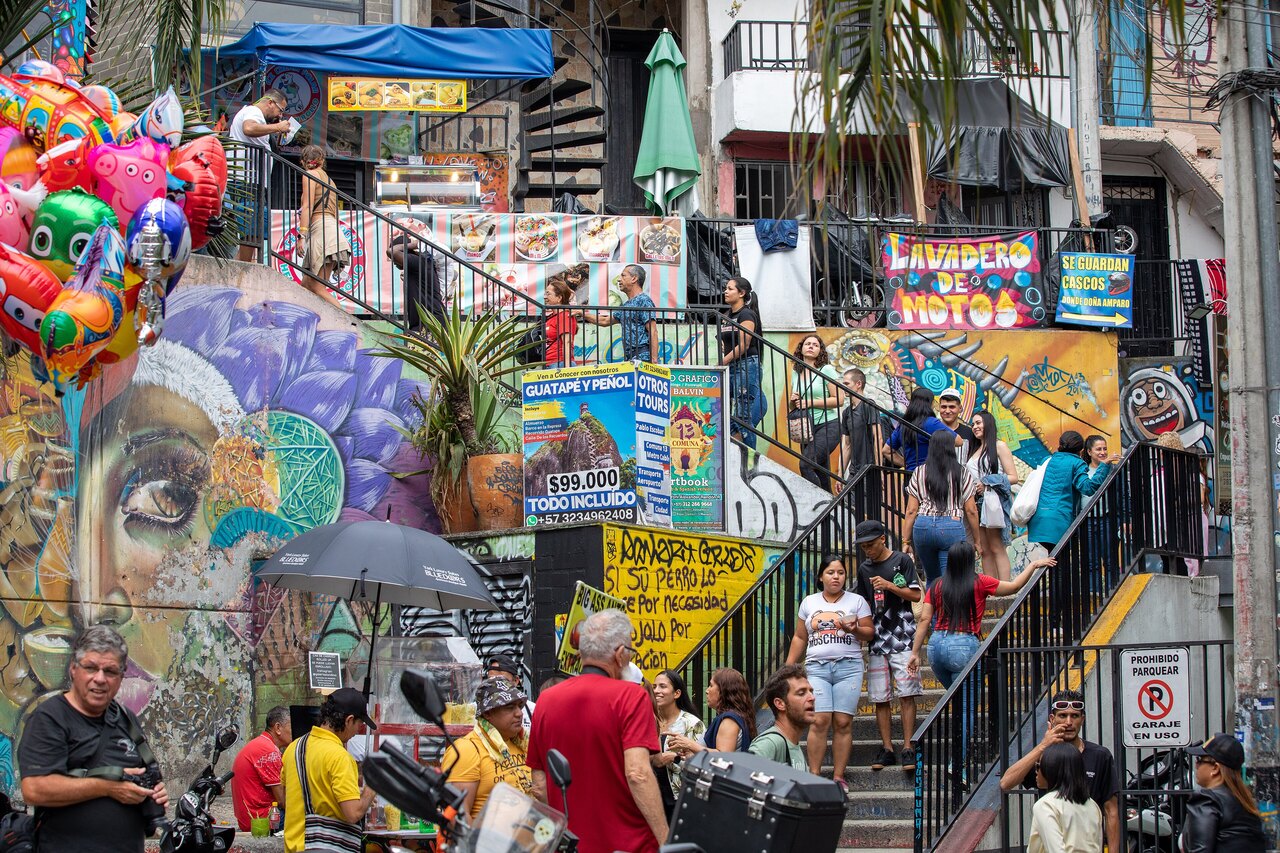
Morning. Take the metro to San Javier station (Line B) and go with a local guide into Comuna 13, once one of the most violent districts in Colombia. The outdoor escalators, opened in 2011, climb the hillside past graffiti murals, and guides who grew up here tell its story (about COP 60,000-120,000).
Afternoon. Return to Acevedo station and ride the Metrocable Line K to Santo Domingo, included in the metro fare, for the view over the city. Change to the Line L cable car (a separate fare of about COP 13,000) for a 15-minute ride over the forest to Parque Arvi.
Evening. Walk the forest trails and market stalls of Parque Arvi until about 16:00, when the last cable cars are busy, then return to El Poblado for dinner along Provenza.
Line L does not run on Mondays (or the next day after a Monday holiday) for maintenance; check before you go.
Day 3: Botanical garden, memory museum and Laureles
Morning. Take the metro to Universidad station for the free Jardin Botanico, with the wooden Orquideorama canopy and resident iguanas. Next door, the Parque Explora science museum and aquarium (about COP 40,000-60,000) is good with children.
Afternoon. Visit the Museo Casa de la Memoria (free), which explains Colombia's armed conflict through the voices of victims; allow 1.5 hours. Then rest in a cafe in Laureles, a flat, tree-lined district where Medellin locals live, around Parque Laureles and the circular streets.
Evening. Join a salsa class or watch locals dance at a bar on La 70, near the stadium. Then try a late-night empanada for COP 3,000-5,000.
On Sundays, the Ciclovia closes main avenues to cars from 7:00 to 13:00 for cyclists and runners; rent a bike from your hotel.
Day 4: Day trip to Guatape and the Penol
Morning. Take a bus from the Terminal del Norte (Caribe metro station) to Guatape, about 2 hours, roughly COP 20,000-25,000 each way. Get off at the Piedra del Penol and climb its 740 steps (entry about COP 25,000-30,000) for the view of the reservoir's islands and inlets.
Afternoon. Take a tuk-tuk 5 minutes into Guatape town, where every house is painted and decorated with zocalos, colourful relief panels along the base of the walls. Lunch on lake trout at the Malecon, then take a 1-hour boat trip on the reservoir (about COP 30,000-50,000).
Evening. Return to Medellin by bus (the last ones leave Guatape around 18:00-19:00), and finish at a rooftop in El Poblado or a specialty coffee bar in Envigado.
Go on a weekday: on Saturdays, Sundays and holidays, the queue for the rock and the traffic back to Medellin can each add an hour.
Only have 3 days?
With 3 days, do Day 1, Day 2 and Guatape, and fit Laureles and La 70 into an evening. You lose the botanical garden and the Casa de la Memoria.
Got extra days?
Add a coffee farm visit in the hills of Santa Elena or Fredonia (half day, about COP 150,000-250,000), a night in the colonial village of Jardin (about 3 hours south-west), or fly 1 hour to Cartagena for the Caribbean coast.
Where to stay in Medellin
| Budget | Area | Why | Typical double/night |
|---|---|---|---|
| Budget | Laureles / Estadio | Flat, calm streets near metro stations, with good-value guesthouses. | COP 80,000-160,000 |
| Mid-range | El Poblado (Provenza / Parque Lleras) | The most hotels, restaurants and nightlife, near Poblado metro. | COP 220,000-400,000 |
| Mid-range | Envigado | A separate town at the south of the valley, quieter, with local restaurants. | COP 180,000-320,000 |
| Comfort | Upper El Poblado / Las Palmas | Hillside hotels with pools and views over the valley. | COP 500,000-1,100,000 |
Getting around
The Metro de Medellin has two main lines along and across the valley, connected to tram, cable cars (Metrocable) and bus lines. A single ride costs about COP 3,500-4,000; buy a Civica card at stations to avoid queues. Taxis are yellow and cheap (COP 10,000-25,000 across town); apps such as Uber, DiDi and Cabify are widely used. Jose Maria Cordova airport is in Rionegro, 45-60 minutes away over the mountains: a taxi costs about COP 100,000-130,000, and shared buses run to the San Diego shopping centre for about COP 20,000.
What to eat in Medellin
Paisa food is filling. The bandeja paisa piles beans, rice, ground beef, chicharron (crispy pork belly), chorizo, fried egg, plantain, arepa and avocado on one plate, for about COP 30,000-45,000. Lunch at local restaurants is a set menu del dia of soup, main and juice for COP 15,000-25,000. Try arepas with cheese, buñuelos (cheese fritters), mondongo (tripe soup) and tropical fruit juices in water or milk. Mercado del Rio, a food hall near the Industriales metro, has dozens of stalls. Coffee from the region is excellent in specialty cafes in Laureles and El Poblado, at COP 6,000-12,000 a cup.
Best time to visit
Medellin is called the 'city of eternal spring', with highs of 26-28°C and lows of about 17°C all year. The drier months are December to March and July to August; April-May and October-November bring heavier afternoon rain. Book early for the Feria de las Flores in early August, with its parade of flower carriers, and for the Christmas lights along the river in December.
Month-by-month weather for Medellin →
What a day costs
| Budget | Mid-range | Comfort | |
|---|---|---|---|
| Bed (per person, sharing a double) | COP 50,000 | COP 140,000 | COP 350,000 |
| Food & drink | COP 60,000 | COP 120,000 | COP 250,000 |
| Sights & tickets | COP 30,000 | COP 80,000 | COP 160,000 |
| Local transport | COP 15,000 | COP 40,000 | COP 100,000 |
| Total per person, per day | about COP 155,000 | about COP 380,000 | about COP 860,000 |
Approximate 2026 prices in Colombian pesos (COP, written with a $ sign locally; about COP 4,000 to the US dollar). Foreign tourists can be exempt from 19% hotel VAT with a passport stamp; restaurants add an optional 10% service charge.
Before you go
Common questions
Is Medellin safe for tourists?
The tourist areas of El Poblado, Laureles and Envigado are generally safe with care, and the metro is well guarded. Phone snatching is the most common problem: do not use your phone openly on the street. Be very careful with dating apps, as foreign men have been drugged and robbed after meeting strangers. Locals say 'no dar papaya': do not give anyone the opportunity.
Is Comuna 13 safe to visit?
Yes, the graffiti tour route with the escalators is one of the most visited places in the city and is safe during the day. Go with a guide from the neighbourhood, who will explain the history and how to behave, and support local businesses. Do not wander into other parts of the district, and avoid taking photos of residents without permission.
How many days do I need for Medellin and Guatape?
Four days is ideal: three in the city and one full day for Guatape. Guatape is easy to visit independently by public bus from the Terminal del Norte, but tours include transport, a boat ride and lunch for about COP 120,000-200,000. Some travellers prefer a night in Guatape to see the town quietly after the day tours leave.
Should I stay in El Poblado or Laureles?
El Poblado has the most choice in hotels, restaurants and nightlife, but it is the most expensive and can be noisy around Parque Lleras on weekends. Laureles is flatter, calmer and more local, with cheaper food and good cafes, and is close to the stadium and La 70. Both are well connected by metro and taxis.
How this guide was made
Compiled by TonyPlan from official tourism, transport and attraction sources and on-the-ground travel knowledge. Prices are approximate for 2026 and change with season; anything we could not confirm is marked as approximate.
Some links on this page are partner links. If you book through them TonyPlan may earn a commission; the price you pay is the same. How we make money.