How many days in Kuwait? 3 days: the towers, the souq and Failaka Island
By Tony Panopoulos · travel-agency planner in Greece · Updated
Kuwait gets few tourists, and that is part of its appeal: a wealthy, conservative Gulf city with a long waterfront, an old souq where locals actually shop, and some of the most ambitious new museums in the region. Three days is enough for Kuwait City, its cultural centres and a ferry to Failaka Island, where Alexander the Great's soldiers once had a fort. Plan everything around the heat: outdoor sights early and after sunset.
Short answer
Two days covers Kuwait Towers, the Grand Mosque, the souq and the cultural centres. The third day adds Failaka Island or the Mirror House and the Tareq Rajab Museum.
The 3-day plan, day by day
Day 1: Kuwait Towers, the Grand Mosque and the souq
Morning. Start at the Kuwait Towers on the Arabian Gulf Street, the 1979 landmark with its blue-green tiled spheres; the observation sphere, 123 metres up, costs about KD 3. Then take a taxi 10 minutes to the Grand Mosque, the largest in the country, which offers free guided tours for visitors on most days outside prayer times (usually mornings); women are lent an abaya.
Afternoon. Visit Sadu House (Bait Al Sadu), a 1930s mud-and-coral house where Bedouin women's weaving, with geometric red and black patterns, is kept alive, then walk to the Kuwait National Museum next door and the restored Seif Palace clock tower from outside.
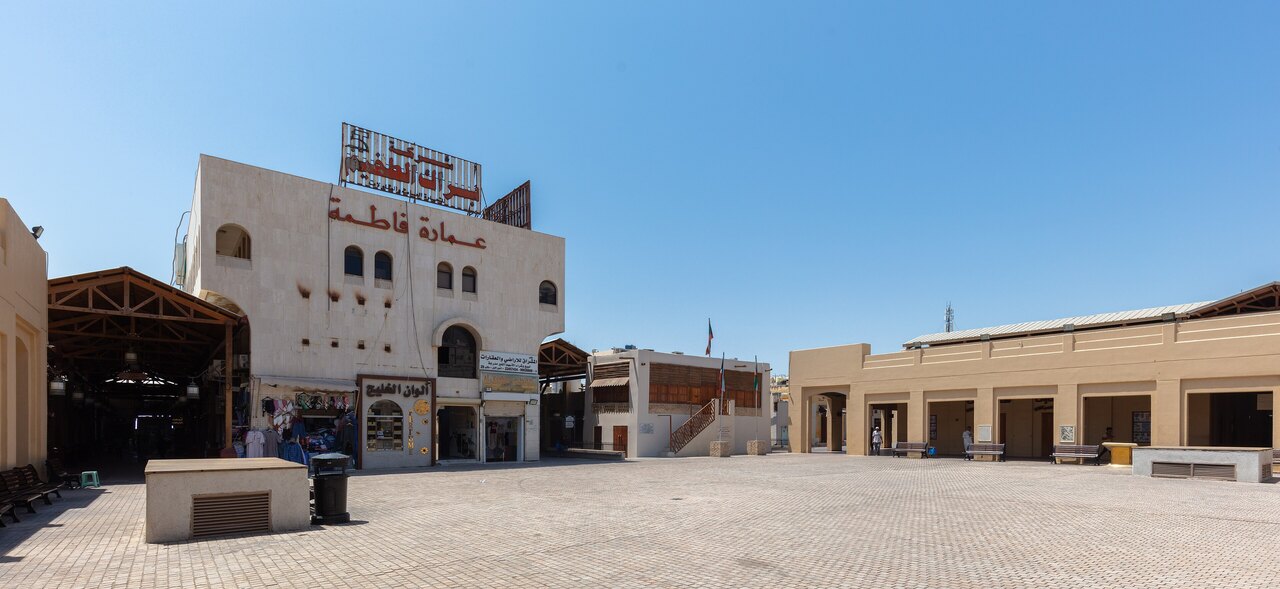
Evening. Spend the evening in Souq Al-Mubarakiya, the old market, with alleys of dates, spices, perfumes, dishdashas and gold. Eat grilled meat and fresh bread in the courtyard restaurants for KD 2-4, and drink sweet tea in the old coffee house.
The Kuwaiti weekend is Friday and Saturday. On Friday most places open only in the afternoon, after midday prayers, and the souq is busiest on Thursday and Friday evenings.
Day 2: The cultural centres and the waterfront
Morning. Go to the Sheikh Abdullah Al Salem Cultural Centre, one of the largest museum complexes in the world, with natural history, science, space and Islamic history museums under one roof; entry is cheap (a few KD) and you could spend 3-4 hours. Book a time slot online in advance.
Afternoon. Rest in Al Shaheed Park across the road, a green park with the Habitat and Remembrance museums, then see the Sheikh Jaber Al-Ahmad Cultural Centre, the opera house complex nicknamed 'the jewels' for its gem-shaped buildings. Check the programme for concerts.
Evening. Walk the Arabian Gulf Street corniche at sunset, past Marina Crescent and Souq Sharq, to dine on seafood or Lebanese food (KD 6-12). Al Hamra Tower, the twisted 413-metre skyscraper, is lit up at night.
There is no alcohol anywhere in Kuwait, including hotels; restaurants serve mocktails and fresh juices instead. Bringing alcohol into the country is illegal.
Day 3: Failaka Island, or the Mirror House
Morning. Take the ferry from Ras Salmiya to Failaka Island, about 20 km offshore (around 1h15; return about KD 4-6, more on the fast boat). See the Ikaros Hellenistic fortress and temple from the time of Alexander the Great's successors, and the older Bronze Age Dilmun site.
Afternoon. On Failaka, tour the heritage village and the buildings still scarred by the 1990-91 Iraqi occupation, then swim from the island beach. Return on an afternoon ferry. Alternatively, stay in the city and visit the Tareq Rajab Museum in Jabriya (about KD 2), a private collection of Islamic calligraphy, jewellery and costume.
Evening. Book a visit to the Mirror House in Qadsiya, the home of artist Lidia Al-Qattan, covered inside and out with mirror mosaics; tours are by appointment, usually in the evening. Have a final dinner of machboos at Freej Swaileh, a traditional Kuwaiti restaurant chain.
Ferry times change with the season and the day of the week; check the current timetable before you go, and bring water and sun protection.
Only have 2 days?
With 2 days, do Day 1 and Day 2 as written. You lose Failaka Island and the Mirror House.
Got extra days?
A 4th day can visit The Avenues, one of the largest malls in the Middle East, the Scientific Center aquarium in Salmiya (about KD 3-5), or the Kuwait House of National Memorial Museum on the 1990-91 occupation. Desert camps open in winter.
Where to stay in Kuwait
| Budget | Area | Why | Typical double/night |
|---|---|---|---|
| Budget | Kuwait City centre (Sharq / Qibla) | Older hotels near the souq and the bus station. | KD 20-35 |
| Mid-range | Salmiya | Busy seafront district with restaurants, cafés and shopping. | KD 30-55 |
| Mid-range | Kuwait City (Sharq) | Business hotels near the towers, the souq and the corniche. | KD 35-60 |
| Comfort | Arabian Gulf Street / beach resorts | Five-star hotels on the water with pools and private beaches. | KD 70-160 |
Getting around
Kuwait is a car city. Taxis and ride-hailing apps such as Careem and Uber are the easiest option; most rides in the city cost KD 2-4. Public buses (KPTC and CityBus) cover the main roads for about 250 fils a ride, but they are slow and crowded. Kuwait International Airport is about 15 km from the centre: 20-30 minutes and KD 5-8 by taxi. Walking is pleasant only along the corniche, and only from November to March.
What to eat in Kuwait
Kuwaiti food mixes Arab, Persian and Indian flavours. Machboos is the national dish: spiced rice with chicken, lamb or fish. Try mutabbaq zubaidi, pomfret fish over rice, gabout, stuffed flour dumplings in tomato stew, and jireesh (crushed wheat). Sweets include luqaimat, fried dough balls with date syrup. Breakfast in the souq is beans, eggs and bread for about KD 1-2. Kuwaitis love cafés and international chains; mall restaurants cost KD 5-12 for a main. Dates are served with gahwa (cardamom coffee) everywhere.
Best time to visit
November to March, with highs of 18-25°C and cool nights. From May to September the heat is extreme, often above 45°C and sometimes 50°C, and outdoor sightseeing is only possible after dark. During Ramadan restaurants close in daylight hours and eating in public is not allowed, but evenings are festive. National Day and Liberation Day on 25-26 February bring celebrations along the Gulf Street.
Month-by-month weather for Kuwait →
What a day costs
| Budget | Mid-range | Comfort | |
|---|---|---|---|
| Bed (per person, sharing a double) | KD 14 | KD 25 | KD 60 |
| Food & drink | KD 6 | KD 14 | KD 30 |
| Sights & tickets | KD 3 | KD 6 | KD 12 |
| Local transport | KD 3 | KD 7 | KD 15 |
| Total per person, per day | about KD 26 | about KD 52 | about KD 117 |
Approximate 2026 prices in Kuwaiti dinars (KD 1 = about US$3.25; 1 dinar = 1,000 fils), the highest-valued currency in the world. There is no tourist tax, but check visa rules and fees for your nationality.
Before you go
Common questions
Do I need a visa for Kuwait?
Many nationalities, including most EU countries, the UK and the US, can get an eVisa online or a visa on arrival, and residents of other Gulf countries often have simplified entry. The rules have changed several times in recent years, so check the official Kuwait eVisa portal for your passport before booking, and travel with a return ticket and hotel booking.
What should I wear in Kuwait?
Dress conservatively in public: for men, long trousers or knee-length shorts and a shirt; for women, loose clothes covering shoulders and knees. Women do not need to cover their hair except in mosques, where an abaya is provided. Swimwear is for hotel pools and private beaches. Malls and cars are strongly air-conditioned, so carry a light layer.
Is Kuwait worth visiting?
For two or three days, yes, especially if you are curious about the Gulf without Dubai's crowds. The cultural centres are world-class and cheap, the souq is authentic, and Failaka has real history. It is not a nightlife or beach destination: there is no alcohol and little organised tourism, so come for museums, food and a glimpse of everyday Gulf life.
Can I combine Kuwait with other countries?
Easily. Flights to Bahrain, Qatar and the UAE take about 1 hour, and Saudi Arabia's eastern province is a few hours' drive south. Kuwait Airways and Jazeera Airways fly widely across the region. Since the GCC is working on a joint tourist visa, check whether a single visa now covers several Gulf states.
How this guide was made
Compiled by TonyPlan from official tourism, transport and attraction sources and on-the-ground travel knowledge. Prices are approximate for 2026 and change with season; anything we could not confirm is marked as approximate.
Some links on this page are partner links. If you book through them TonyPlan may earn a commission; the price you pay is the same. How we make money.