How many days in Geneva? 3 days, with the lake and Lavaux vineyards
By Tony Panopoulos · travel-agency planner in Greece · Updated
Geneva is small and expensive, which is why most visitors give it one day. Give it three: one for the old town and the lake, one for the international city of the United Nations, the Red Cross museum and CERN, and one on the water or the train to the Lavaux vineyards and Château de Chillon. The trick that cuts the cost: hotel guests get a free Geneva Transport Card for buses, trams, trains within the city and the yellow lake shuttles.
Short answer
Two days covers the old town, the lakefront, the UN and Carouge. The third day adds the Lavaux terraces and Chillon castle, or a cable car up the Salève for a view over the whole lake.
The 3-day plan, day by day
Day 1: Old town and the lakefront
Morning. Climb into the Vieille Ville to St-Pierre Cathedral, where Calvin preached. The north tower (about CHF 7) has the best view in the city, and the archaeological site underneath shows 2,000 years of buildings. Walk 3 minutes to Place du Bourg-de-Four, the oldest square, and the Maison Tavel, the city's oldest house (free).
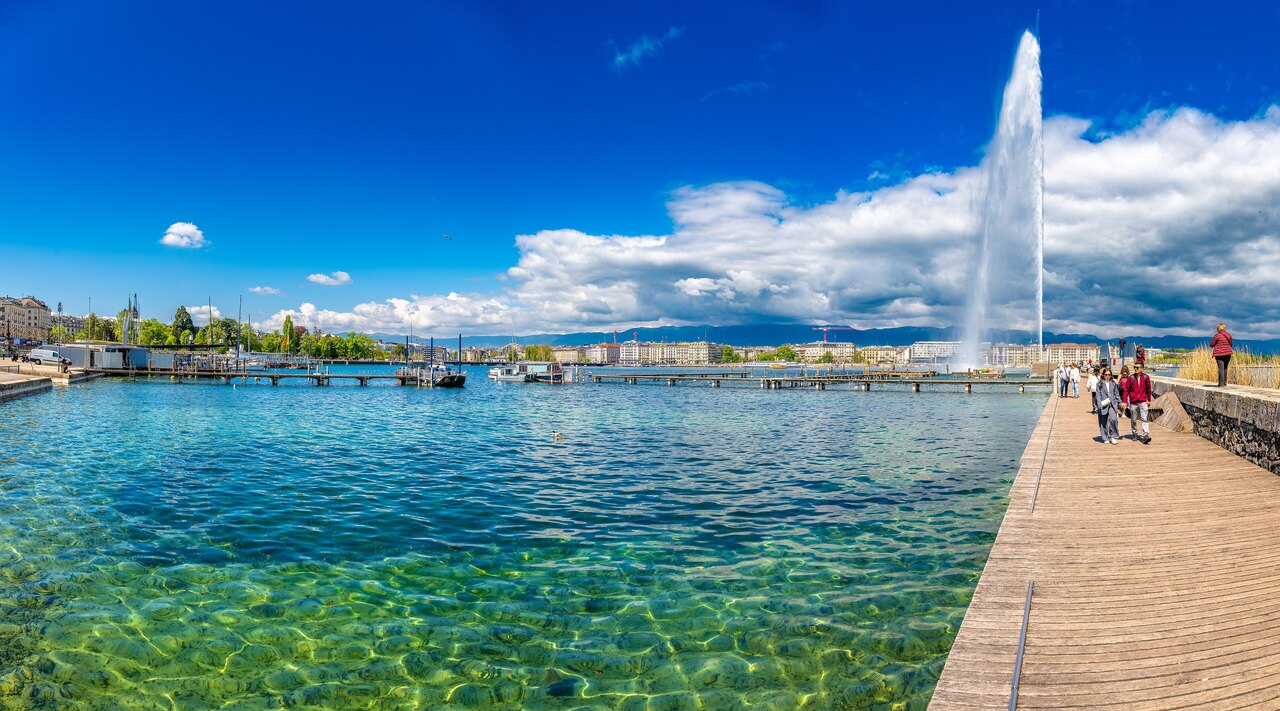
Afternoon. Walk down through Parc des Bastions to the Reformation Wall, a 100-metre stone monument to Calvin and his followers. Then cross to the lake at the Jardin Anglais and its flower clock, and follow the quay to the Jet d'Eau, which shoots water 140 metres into the air.
Evening. Take a 'Mouette' shuttle boat across the harbour (included with the transport card) to the Bains des Pâquis, a 1930s lake bath with a sauna and a cheap buvette that serves cheese fondue from autumn to spring, about CHF 25.
The Jet d'Eau is switched off in strong wind, frost and for maintenance. Check before you walk out on the jetty.
Day 2: International Geneva and CERN
Morning. Take tram 15 to Nations. Book a guided tour of the Palais des Nations, the UN's European headquarters (about CHF 22, passport needed, booked online). Outside, the Broken Chair sculpture stands on the Place des Nations.
Afternoon. Cross the road to the International Red Cross and Red Crescent Museum (about CHF 15), one of the most moving museums in Switzerland. Then take tram 18 about 25 minutes to CERN and its Science Gateway, opened in 2023, with free exhibitions on particle physics.
Evening. Return to Carouge, a small Sardinian-built town south of the centre with low Italianate houses, artisans and wine bars. A plate of perch fillets from the lake (filets de perche) costs CHF 35-45.
The UN tours need booking several days ahead and run on weekdays only; bring your passport, or you will be refused at security.
Day 3: Lavaux, Lausanne and Chillon
Morning. Take the train from Geneva Cornavin to Lausanne (about 35-45 minutes, about CHF 28 each way at full fare, less with Supersaver tickets). Change to the local train to Cully or Lutry and walk through the Lavaux terraces, a UNESCO site of stone-walled vineyards above the lake; Cully to Epesses is about 1 hour.
Afternoon. Continue by train to Montreux (about 20 minutes) and walk the lakeside path 45 minutes to the Château de Chillon (about CHF 15), a medieval castle on a rock in the water, made famous by Byron's poem.
Evening. Take the lake boat back towards Lausanne (paddle steamers of the CGN run mainly in summer), visit the Olympic Museum at Ouchy if you are early, then the train to Geneva.
Stop at a caveau in Lavaux, a village wine cellar run by the growers, for a glass of Chasselas, about CHF 5-7.
Only have 2 days?
With 2 days, do Day 1 and combine the Palais des Nations and the Red Cross museum with an evening in Carouge on Day 2. You lose CERN and the lake day.
Got extra days?
A 4th day can go to Chamonix and the Aiguille du Midi cable car facing Mont Blanc (about 1h15 by bus, in France, so bring your passport), or up the Salève by cable car (about 30 minutes from the city) for a walk above the lake. Annecy, with its canals, is about 45 minutes by bus.
Where to stay in Geneva
| Budget | Area | Why | Typical double/night |
|---|---|---|---|
| Budget | Pâquis | The cheapest rooms in town, near Cornavin station and the lake, with many cheap restaurants. | CHF 130-200 |
| Mid-range | Cornavin station area | Trains to the airport in 7 minutes and to Lausanne, walk to the lake. | CHF 200-320 |
| Mid-range | Plainpalais / Carouge | Local neighbourhoods with markets, bars and easy trams. | CHF 180-300 |
| Comfort | Quai du Mont-Blanc | Grand lakeside hotels facing the Jet d'Eau and the Alps. | CHF 450-1,000 |
Getting around
Most of central Geneva is a 20-minute walk across. Hotels, hostels and campsites give guests a Geneva Transport Card for free public transport during their stay, including the yellow Mouettes boats. Otherwise a one-hour ticket costs about CHF 3. At the airport, take a free 80-minute ticket from the machine in the baggage hall; the train to Cornavin takes 7 minutes. For day trips, Swiss trains are punctual but expensive; look for Supersaver tickets on the SBB app, often 50-70% cheaper on off-peak trains.
What to eat in Geneva
Swiss cheese dishes are the classic: fondue moitié-moitié (Gruyère and Vacherin) and raclette, best from October to March, about CHF 30-40. The local speciality is filets de perche, small lake perch fried in butter. Geneva also has longeole, a fennel pork sausage with a protected status. The cheapest good meals are in the Pâquis area, which is full of Lebanese, Ethiopian and Portuguese places at CHF 18-28 a main. Lunch menus (plat du jour) cost CHF 20-28 in most bistros. Buy chocolate at Favarger or Auer, and wine from the Geneva vineyards of Satigny, the largest wine-growing commune in Switzerland.
Best time to visit
May to September for lake swimming, boat trips and outdoor terraces, with highs of 22-28°C. July and August are busiest; the Fêtes de Genève has fireworks over the lake in August. December has the Escalade festival (around 11-12 December) with chocolate cauldrons, and the Christmas market. Winter is grey and cold (around 0-6°C) but good for cheese restaurants and skiing an hour away. Big watch fairs and UN conferences can fill hotels at short notice, so book early.
Month-by-month weather for Geneva →
What a day costs
| Budget | Mid-range | Comfort | |
|---|---|---|---|
| Bed (per person, sharing a double) | CHF 70 | CHF 130 | CHF 300 |
| Food & drink | CHF 50 | CHF 90 | CHF 170 |
| Sights & tickets | CHF 15 | CHF 35 | CHF 60 |
| Local transport | CHF 5 | CHF 25 | CHF 50 |
| Total per person, per day | about CHF 140 | about CHF 280 | about CHF 580 |
Approximate 2026 prices in Swiss francs (CHF), with day-trip train fares averaged in; Geneva adds a city tax of about CHF 2.50-5 per person per night, which pays for the free transport card.
Before you go
Common questions
Can I pay in euros in Geneva?
Many shops, hotels and restaurants accept euros, but at a poor rate and with change in francs. Cards and contactless payment work almost everywhere, including buses' ticket machines and markets. Withdraw or pay in Swiss francs. Remember that much of the area around Geneva is France, which uses euros, so check which side of the border you are on.
Is the Geneva Transport Card really free?
Yes, if you stay overnight in a hotel, hostel or campsite in the canton of Geneva. You get it at check-in, often by email or QR code, and it covers city buses, trams, trains in the Geneva zone and the yellow Mouettes boats for your whole stay. It does not cover trains to Lausanne or the large CGN lake steamers.
Can I visit CERN for free?
Yes. The Science Gateway, the visitor centre opposite the main site, is free and open most days except Mondays, with exhibitions, labs and shows. Free guided tours of parts of the laboratory are offered too, but places are limited and released online in advance. Tram 18 from Cornavin takes about 25 minutes.
Is a day trip to Chamonix worth it?
Yes on a clear day. Buses from Geneva airport and the bus station take about 1h15 to 1h30. The Aiguille du Midi cable car rises to 3,842 metres facing Mont Blanc and costs around €80 return. Check the forecast and webcams before going: in cloud there is nothing to see at the top.
How this guide was made
Compiled by TonyPlan from official tourism, transport and attraction sources and on-the-ground travel knowledge. Prices are approximate for 2026 and change with season; anything we could not confirm is marked as approximate.
Some links on this page are partner links. If you book through them TonyPlan may earn a commission; the price you pay is the same. How we make money.