How many days in Malta? 4 days: Valletta, Mdina, Gozo and the Blue Lagoon
By Tony Panopoulos · travel-agency planner in Greece · Updated
Malta packs 7,000 years of history into an archipelago smaller than many cities. Four days covers the capital Valletta, the walled Three Cities across the Grand Harbour, the medieval hilltop of Mdina, and a day on Gozo, with an option for the turquoise Blue Lagoon on Comino. Distances are short (the main island is 27 km long) but the buses are slow, so group sights by area and use the ferries.
Short answer
Three days covers Valletta, Mdina and Gozo. The fourth day adds the Three Cities, the Blue Lagoon or the Sunday fish market at Marsaxlokk.
The 4-day plan, day by day
Day 1: Valletta
Morning. Start at St John's Co-Cathedral (about €15), plain outside and covered in gold inside, with marble tombs of the Knights. The oratory holds Caravaggio's Beheading of St John the Baptist, the only painting he signed. Arrive at opening; it closes in the early afternoon on some days and is closed on Sundays to visitors.
Afternoon. Walk the grid of the 16th-century city to the Upper Barrakka Gardens for the view of the Grand Harbour; the Saluting Battery below fires a cannon at 12:00 and 16:00. Visit the Grandmaster's Palace or the Lascaris War Rooms, the underground WWII command centre.
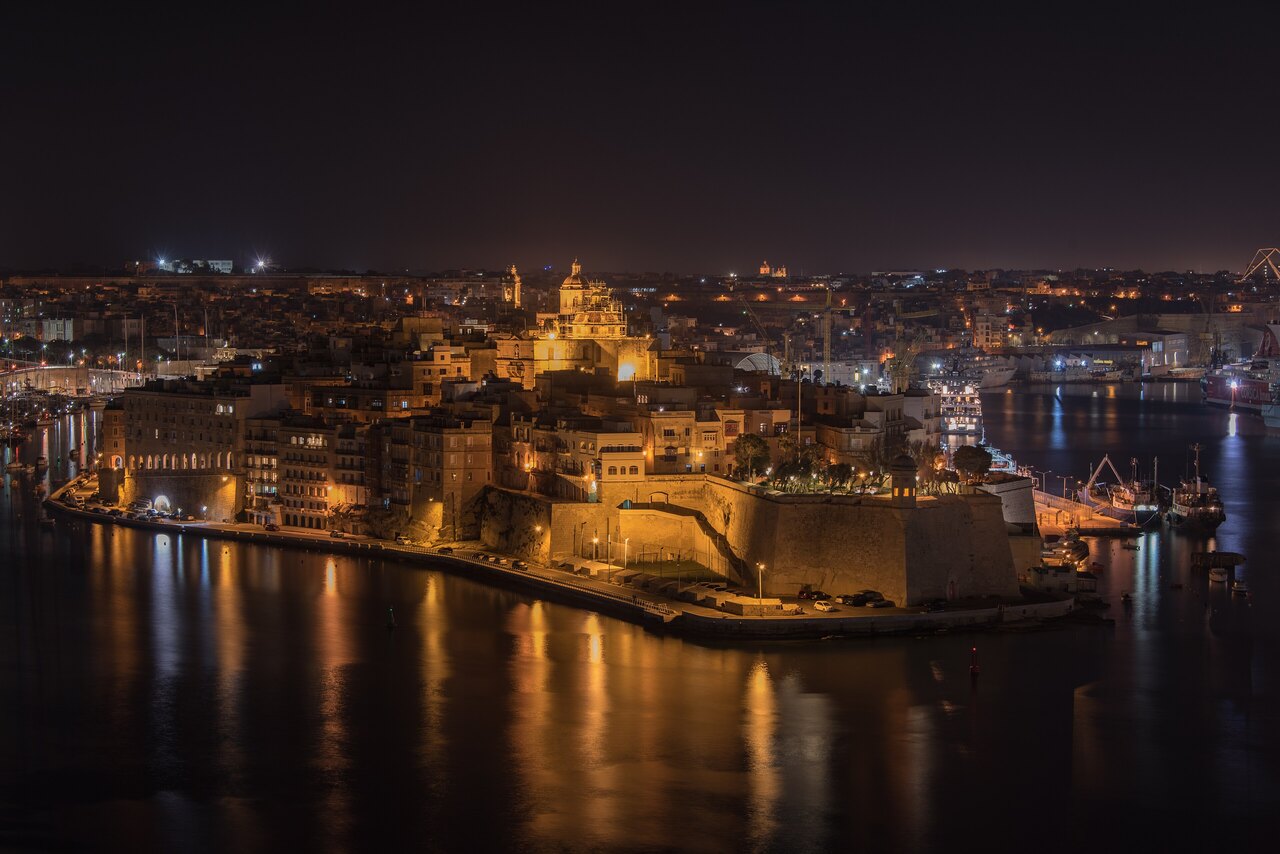
Evening. Have dinner on Strait Street, once the sailors' red-light street, now lined with wine bars, and walk the illuminated bastions.
Valletta is steep at its edges. The Barrakka Lift connects the Upper Barrakka Gardens with the waterfront in 25 seconds.
Day 2: The Three Cities and the Hypogeum
Morning. Book the Ħal Saflieni Hypogeum weeks or months ahead: an underground prehistoric burial complex carved around 4000 BC, limited to small groups per hour (about €35-50). It is in Paola, 15 minutes by bus from Valletta.
Afternoon. From Valletta's waterfront, cross to Birgu (Vittoriosa) by traditional dgħajsa water taxi (a few euros) or the ferry. Walk Birgu's lanes, Fort St Angelo, and the waterfront marina, then Senglea's Gardjola Gardens for the view back to Valletta.
Evening. Have dinner at a waterfront restaurant in Birgu, then take the boat back across the harbour at night.
If the Hypogeum is sold out, the Tarxien Temples near it and the cliff-top temples of Ħaġar Qim and Mnajdra are easier to visit and nearly as old.
Day 3: Mdina and the west
Morning. Take the bus about 30 minutes to Mdina, the walled 'Silent City' and former capital, with almost no cars. See the St Paul's Cathedral and the bastion view across the island.
Afternoon. Walk 5 minutes into Rabat for St Paul's Catacombs (early Christian burial galleries), then take the bus to the Dingli Cliffs or to Golden Bay and the Għajn Tuffieħa beach for a swim.
Evening. Watch the sunset over the sea from Golden Bay or the Dingli Cliffs, then return to Valletta or Sliema.
Mdina is at its most atmospheric at night, when the lanes are lit and empty. Stay for dinner if you can.
Day 4: Gozo (and the Blue Lagoon)
Morning. Take bus or car to Ċirkewwa and the ferry to Gozo (about 25 minutes, paid only on the return trip, a few euros). From Mġarr, take a bus to Victoria and its walled Citadel, then to the Ġgantija temples (around 3600 BC), older than Stonehenge and the Pyramids.
Afternoon. Visit the cliffs of Dwejra, where the Azure Window arch collapsed in 2017, and the Inland Sea, or swim at the red sand of Ramla Bay. Gozo is best seen by hop-on hop-off bus or a hired car.
Evening. Return on the ferry at sunset. Alternatively, take a boat from Ċirkewwa or Sliema to Comino's Blue Lagoon; visitor numbers are now controlled with a booking system, so reserve a slot in summer.
The Blue Lagoon is packed from 11:00 to 15:00. The first boat of the morning or a late-afternoon trip is far more pleasant.
Only have 3 days?
With 3 days, do Days 1, 3 and 4, and visit the Three Cities by boat on the first evening.
Got extra days?
On a Sunday, visit Marsaxlokk's fish market among the painted luzzu boats, and take a boat into the Blue Grotto sea caves at Wied iż-Żurrieq (weather permitting). Divers can spend days on Malta's wrecks and reefs.
Where to stay in Malta
| Budget | Area | Why | Typical double/night |
|---|---|---|---|
| Budget | Gżira / St Julian's back streets | Cheaper, many buses and ferries; St Julian's is the nightlife centre. | €70-110 |
| Mid-range | Valletta | Walk to the sights, ferries to Sliema and the Three Cities, beautiful at night. | €120-200 |
| Mid-range | Sliema | Seafront promenade, rocky swimming spots, ferry to Valletta. | €100-170 |
| Comfort | Valletta palazzo hotels / Gozo farmhouses | Historic boutique hotels or a pool villa on Gozo. | €200-450 |
Getting around
Buses (Tallinja) reach every town from Valletta's terminus; a ticket is about €2.50 in summer and a 12-journey Explore card is better value. Buses are slow and crowded in summer, so allow extra time. The Sliema-Valletta ferry takes 10 minutes. Driving is on the left; car hire helps on Gozo. From the airport, buses X4 to Valletta take about 25 minutes, and taxis about 20 minutes.
What to eat in Malta
Start with pastizzi, flaky pastries filled with ricotta or mushy peas, sold for under €1 at pastizzerias such as Crystal Palace in Rabat. Malta's national dish is stuffat tal-fenek, rabbit stewed in wine and garlic, best in village restaurants. Try ftira, a ring-shaped bread filled with tuna, tomatoes, capers and olives, and ġbejniet, small sheep's cheeses from Gozo. At Marsaxlokk, order lampuki (dolphinfish), in season from late August, grilled or in a pie. Local drinks are Kinnie, a bitter-orange soft drink, Cisk lager, and Maltese wines from Gozo's vineyards. A two-course dinner costs €20-35 per person.
Best time to visit
April to June and September to October, with highs of 20-28°C and warm sea from June. July and August are hot (31-32°C) and busy. Every village celebrates its patron saint with a festa between June and September, with fireworks, brass bands and street decorations. Winter is mild (around 16°C), quiet and good for history.
Month-by-month weather for Malta →
What a day costs
| Budget | Mid-range | Comfort | |
|---|---|---|---|
| Bed (per person, sharing a double) | €40 | €75 | €160 |
| Food & drink | €20 | €40 | €80 |
| Sights & boats | €15 | €35 | €70 |
| Local transport | €5 | €10 | €40 |
| Total per person, per day | about €80 | about €160 | about €350 |
Approximate 2026 prices. Malta charges an eco-contribution of a small amount per person per night (capped per stay), paid at the hotel.
Before you go
Common questions
Do I need a car in Malta?
Not on the main island; buses and ferries cover everything. On Gozo, a car or the hop-on hop-off bus saves time.
Is the Hypogeum worth booking so early?
Yes, if prehistoric history interests you: there is nothing like it in the world, and tickets for small groups sell out weeks in advance.
Is Malta good for swimming?
Yes, from June to October. Many coastlines are rocky with ladders into clear water; sandy beaches include Golden Bay, Għajn Tuffieħa, Mellieħa and Ramla on Gozo.
What language do people speak?
Maltese and English are both official, so communication is easy. Driving is on the left, as in the UK.
How this guide was made
Written by hand, without AI, from experience planning Mediterranean trips. Prices are approximate for 2026; confirm on the official Heritage Malta, St John's Co-Cathedral, Gozo Channel and Malta Public Transport websites before booking.
Some links on this page are partner links. If you book through them TonyPlan may earn a commission; the price you pay is the same. How we make money.