How many days in Laos? 7 days, Luang Prabang to Vientiane by the new railway
By Tony Panopoulos · travel-agency planner in Greece · Updated
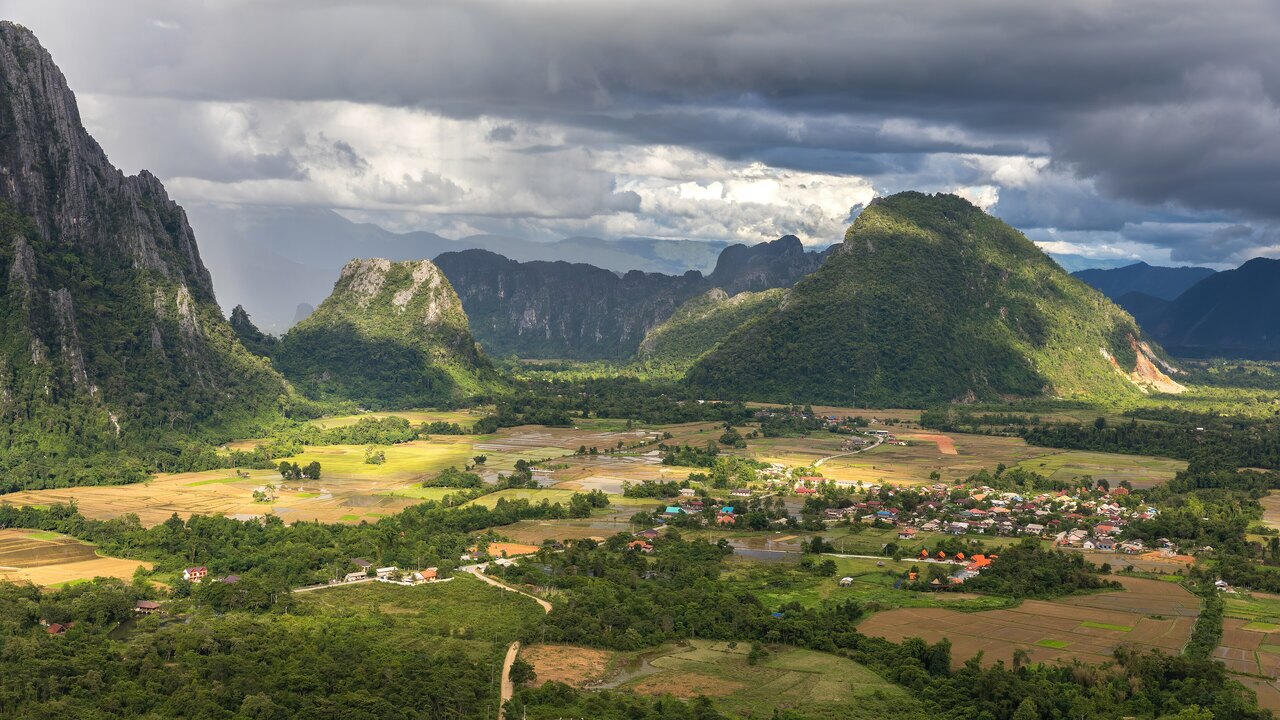
Laos used to mean long, winding bus rides through the mountains. Since the Laos-China Railway opened in 2021, the three places most visitors come for sit on one line: Luang Prabang to Vang Vieng takes about 1 hour, and Vang Vieng to Vientiane about another hour. Give the country seven days: three in Luang Prabang, the royal town of gilded temples where the Nam Khan meets the Mekong, two among the limestone peaks of Vang Vieng, and two in the low-key capital. The pace here is slow; let it be.
Short answer
Five days covers Luang Prabang (three days) and Vang Vieng (two), flying out from Vientiane. Seven days adds the capital properly, with That Luang, the COPE centre and the Mekong sunset.
The 7-day plan, day by day
Day 1: Luang Prabang: the old town and Mount Phousi
Morning. Walk the peninsula of the UNESCO-listed old town, between the Mekong and the Nam Khan. Start at Wat Xieng Thong (about ₭30,000), built in 1560, whose sweeping roofs and 'tree of life' mosaic are the town's emblem.
Afternoon. Visit the Royal Palace Museum (about ₭30,000-60,000; closed at midday and on Tuesdays), the former king's residence, with the Pha Bang Buddha image in its own temple. Dress modestly: shoulders and knees covered.
Evening. Climb the 328 steps of Mount Phousi (about ₭30,000) for sunset over the rivers, then walk down into the night market on Sisavangvong Road, where a buffet plate of noodles and salads costs about ₭20,000-30,000.
Rent a bicycle for about ₭30,000-50,000 a day; the old town is flat and only about 2 km long.
Day 2: Alms round and Kuang Si waterfall
Morning. At about 5:30, watch the tak bat alms round, when lines of monks walk barefoot to collect sticky rice. Stand back quietly on the opposite side of the street, do not use flash, and do not join in unless you mean to. Then have breakfast at the morning market near the Royal Palace.
Afternoon. Take a tuk-tuk or minivan 45 minutes south to Kuang Si (about ₭60,000), a series of turquoise limestone pools where you can swim, with a moon bear rescue centre at the entrance. Climb the steep trail to the top of the main 60-metre fall.
Evening. Have dinner on the Nam Khan riverside, with laap (minced meat salad with herbs) and mok pa (fish steamed in banana leaf), and a Beerlao.
Go to Kuang Si after 14:00, when the morning tour groups leave, or at opening at 8:00.
Day 3: Pak Ou caves by Mekong boat
Morning. Take a slow boat about 2 hours upstream on the Mekong to the Pak Ou caves, two caves in a limestone cliff filled with thousands of Buddha statues left by pilgrims (entry about ₭20,000-30,000; shared boats about ₭100,000-150,000 per person).
Afternoon. Stop on the way back at Ban Xang Hai, the 'whisky village', where locals distil lao-lao rice spirit, and at a weaving village. Then visit the Traditional Arts and Ethnology Centre (TAEC) on Phousi's slope.
Evening. Cross the bamboo bridge over the Nam Khan in the dry season (a small toll), rebuilt by hand each year after the rains, for dinner on the far bank.
Buy Laos-China Railway tickets for tomorrow early: seats sell out days ahead, especially at weekends and holidays.
Day 4: Train to Vang Vieng and the Nam Song river
Morning. Take the Laos-China Railway from Luang Prabang station, about 15-20 minutes from town, to Vang Vieng (about 1 hour; second-class seats from roughly ₭200,000-250,000). The track crosses tall bridges and tunnels through the mountains.
Afternoon. Kayak or tube down the Nam Song river (about ₭100,000-200,000 with transport) past the karst cliffs; tubing is far calmer than its party days.
Evening. Watch the sunset over the peaks from a riverside bar, then eat at the town's night market.
Bring your passport to buy train tickets and to board; the station runs airport-style bag checks.
Day 5: Vang Vieng: caves, lagoons and viewpoints
Morning. At dawn, ride a hot-air balloon over the valley (about US$90-120) or climb the Pha Ngern viewpoint, about 45-60 minutes up a steep trail, for the whole valley below.
Afternoon. Ride a scooter or buggy 7 km west to the Blue Lagoon 1 and Tham Phu Kham cave, where you can swim and climb up to a reclining Buddha (about ₭20,000-30,000). Other numbered lagoons are quieter.
Evening. Have dinner on the Nam Song with views of the floodlit cliffs.
Rent good shoes or sandals with grip; the cave and viewpoint trails are rough and muddy after rain.
Day 6: Vientiane: That Luang and COPE
Morning. Take the train about 1 hour to Vientiane; the station is about 20 km from the centre, so allow 30-40 minutes by shuttle or taxi. Visit Pha That Luang (about ₭30,000), the gold-covered stupa that is the national symbol.
Afternoon. See the COPE Visitor Centre (free), which explains the legacy of US bombing in the 1960s-70s, when Laos became the most heavily bombed country per person in history, and the prosthetics made for victims of unexploded ordnance today.
Evening. Climb the Patuxai victory arch for the view, then walk the Mekong riverfront at sunset as the night market opens, with Thailand across the water.
Vientiane is spread out; use the LOCA ride-hailing app for tuk-tuks and cars at fixed prices.
Day 7: Vientiane: temples and Buddha Park
Morning. Visit Wat Si Saket (about ₭30,000), the oldest surviving temple in the city, with over 6,000 small Buddha images in its cloister walls, and Haw Phra Kaew opposite.
Afternoon. Take a taxi or bus about 45 minutes south-east to Buddha Park (Xieng Khuan, about ₭40,000), a garden of over 200 concrete statues of Buddhist and Hindu figures, built from 1958.
Evening. Have a farewell dinner of khao piak sen, chicken noodle soup, or a herbal sauna and massage at a temple, about ₭50,000-100,000.
Wattay airport is only 4 km from the centre, about 15 minutes by taxi.
Only have 5 days?
With 5 days, spend three in Luang Prabang and two in Vang Vieng, then take the train to Vientiane for an evening flight. You lose the capital's temples and COPE.
Got extra days?
Extra days fit the slow boat on the Mekong from Huay Xai on the Thai border to Luang Prabang (2 days), the Plain of Jars in Phonsavan, or the far south: the 4,000 Islands (Si Phan Don) and the Khone Phapheng falls.
Where to stay in Laos
| Budget | Area | Why | Typical double/night |
|---|---|---|---|
| Budget | Luang Prabang old town guesthouses / Vang Vieng centre | Simple rooms with fans or air-conditioning and breakfast, walking distance to markets. | ₭300,000-600,000 |
| Mid-range | Luang Prabang peninsula | Restored wooden houses between the temples and the rivers. | ₭900,000-2,000,000 |
| Mid-range | Vang Vieng riverside | Bungalows facing the karst cliffs across the Nam Song. | ₭800,000-1,800,000 |
| Comfort | Luang Prabang boutique resorts / Vientiane riverfront | Colonial villas with pools near the old town, or Mekong-view hotels. | ₭3,000,000-7,000,000 |
Getting around
The Laos-China Railway is the backbone: Luang Prabang-Vang Vieng about 1 hour, Vang Vieng-Vientiane about 1 hour, Luang Prabang-Vientiane about 2 hours direct. Buy tickets with your passport at stations, through the LCR app, or via an agent, and book early. Stations are outside town centres, so add 20-40 minutes. In towns, use tuk-tuks (agree prices first) or the LOCA app in Vientiane and Luang Prabang. Scooters rent for about ₭100,000-150,000 a day; roads are poor outside town.
What to eat in Laos
Lao food is fresh, herbal and eaten with sticky rice rolled into balls by hand. Try laap, the national dish of minced meat or fish with lime and mint; tam mak hoong, a fierce green papaya salad; Luang Prabang's khao soi, rice noodles in a tomato and pork sauce; and sai oua sausage. Breakfast is often khao piak sen or a French-style baguette sandwich, khao jee pâté, a legacy of colonial rule. A street meal costs ₭25,000-50,000, a restaurant meal ₭100,000-250,000. Drink Beerlao or lao-lao rice spirit, and only bottled water.
Best time to visit
November to February is cool and dry, with highs of 25-30°C and cold mornings in the north; it is high season. March to May is hot (often 35°C) and hazy from field burning, which can hide the views. The rainy season, June to October, is green, with full waterfalls and fewer visitors, but some roads flood. Pi Mai Lao, the new year water festival in mid-April, means three days of soaking in the streets.
Month-by-month weather for Laos →
What a day costs
| Budget | Mid-range | Comfort | |
|---|---|---|---|
| Bed (per person, sharing a double) | ₭200,000 | ₭600,000 | ₭2,000,000 |
| Food & drink | ₭250,000 | ₭500,000 | ₭1,000,000 |
| Sights & tickets | ₭80,000 | ₭200,000 | ₭600,000 |
| Local transport | ₭100,000 | ₭250,000 | ₭600,000 |
| Total per person, per day | about ₭630,000 | about ₭1,550,000 | about ₭4,200,000 |
Approximate 2026 prices in Lao kip (₭); the kip has lost value fast in recent years, so check the current rate, and many hotels and tours quote in US dollars.
Before you go
Common questions
Do I need a visa for Laos?
Most visitors need one. You can get an e-visa online through the official Lao government portal before you go, or a visa on arrival at Luang Prabang and Vientiane airports and the main land crossings, usually about US$40-45 depending on nationality, paid in US dollars. Bring a passport photo. Several ASEAN nationalities enter visa-free.
How do I buy Laos-China Railway tickets?
With your passport, at a station ticket office, through the official LCR ticket app, or through a travel agent or your guesthouse for a small fee. Tickets open a few days ahead and often sell out, especially on weekends and holidays. Arrive at the station at least 45-60 minutes before departure for security checks; stations are outside the towns.
Should I take cash?
Yes. Laos is mostly a cash economy; small guesthouses, markets, tuk-tuks and temples take only kip, and ATMs charge fees and give small amounts per withdrawal. US dollars and Thai baht are accepted in some tourist places. Larger hotels and some restaurants in Luang Prabang take cards, sometimes with a 3% surcharge.
How should I behave at the alms round?
Watch from a respectful distance, on the opposite side of the street, in silence, with shoulders and knees covered. Do not use flash or block the monks' path, and never touch a monk. If you want to give, buy sticky rice from a local market rather than street sellers, and kneel lower than the monks. Avoid tour groups that treat it as a show.
How this guide was made
Compiled by TonyPlan from official tourism, transport and attraction sources and on-the-ground travel knowledge. Prices are approximate for 2026 and change with season; anything we could not confirm is marked as approximate.
Some links on this page are partner links. If you book through them TonyPlan may earn a commission; the price you pay is the same. How we make money.