How many days in Verona? 3 days: the Arena, the river hills and a day on Lake Garda
By Tony Panopoulos · travel-agency planner in Greece · Updated
Most visitors give Verona half a day between Venice and Milan, see Juliet's balcony in a crowd and leave. Give it three days. The old town sits inside a loop of the Adige river, small enough to cross on foot in 20 minutes, with a 2,000-year-old Roman amphitheatre still used for opera, the tombs of the medieval Scaligeri lords and some of Italy's best red wine in the hills behind. Day three goes to Lake Garda, 30 minutes away.
Short answer
Two days covers the Arena, Piazza delle Erbe, the Lamberti tower, Castel San Pietro and San Zeno. The third day is for Lake Garda or the Valpolicella wineries.
The 3-day plan, day by day
Day 1: The Arena, Piazza delle Erbe and the Lamberti tower
Morning. Start in Piazza Bra at the Arena, a Roman amphitheatre built around AD 30 that once held about 30,000 people (about €12-15 entry; shorter hours on opera days). Climb the stone steps to the top tier for the view of the square. Then walk 10 minutes along Via Mazzini, the marble-paved shopping street, to Piazza delle Erbe, the old Roman forum with its market stalls and the Madonna Verona fountain.
Afternoon. Take the lift or climb 368 steps up the Torre dei Lamberti (about €8-10), 84 metres high, for the best view over the red roofs. Step through the arch into Piazza dei Signori, with its statue of Dante, who lived in Verona in exile, and see the Gothic Scaligeri Tombs (Arche Scaligere) behind wrought-iron railings.
Evening. From June to early September, see an opera at the Arena di Verona Opera Festival; unreserved stone-step seats start at about €30-40, numbered seats at €80-250. Bring a cushion and water. On other nights, have an aperitivo of Spritz in Piazza delle Erbe (about €6-8).
The VeronaCard (about €27 for 24 hours, €32 for 48 hours) covers the Arena, the Lamberti tower, Juliet's House, Castelvecchio and the main churches, and pays off with three or four visits.
Day 2: Juliet's House, the Roman Theatre and Castel San Pietro
Morning. Go to Juliet's House (Casa di Giulietta) on Via Cappello at opening (about €12 for the house), a 13th-century house with the famous balcony added in the 1930s; the courtyard is less crowded before 10:00. Then visit Sant'Anastasia, Verona's largest church, with Pisanello's fresco of St George and the hunchback figures holding up the holy water stoups.
Afternoon. Walk to the Duomo and cross the Ponte Pietra, the Roman stone bridge rebuilt with its original stones after it was blown up in 1945. On the far bank, visit the Roman Theatre and the Archaeological Museum above it (about €8-10).
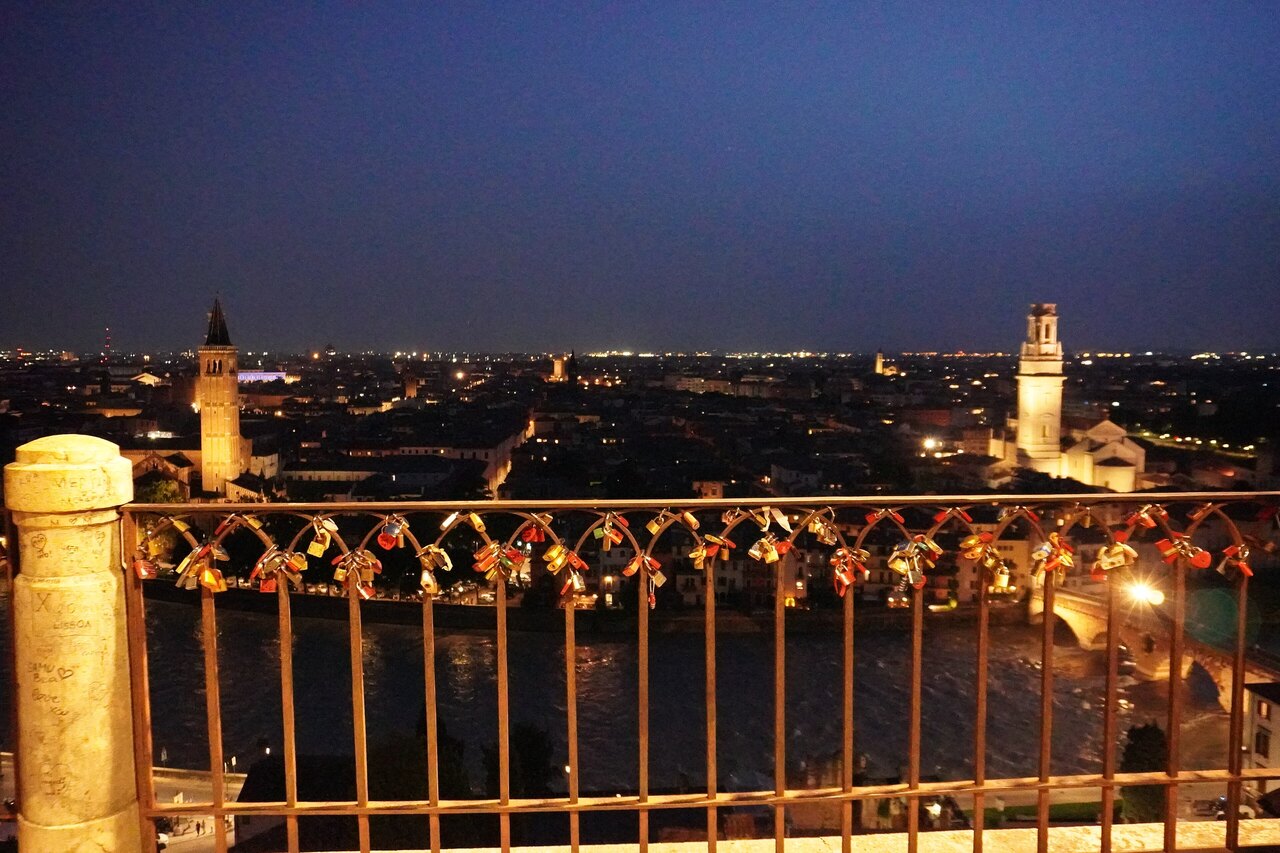
Evening. Take the funicular (about €2 one way, €3 return) or climb the steps to Castel San Pietro for sunset, the best view of the old town inside the river bend. Then eat in the Veronetta district on the left bank, where trattorias are cheaper and full of students, with mains at €12-18.
Juliet was fictional, and the house has no real link to Shakespeare's story. Go for the atmosphere; skip the queue to touch the bronze statue.
Day 3: San Zeno and Castelvecchio, or Lake Garda
Morning. Walk 20 minutes west to the Romanesque Basilica di San Zeno (about €4-6), with its bronze doors of 48 panels and a Mantegna altarpiece. Then walk back along the river to Castelvecchio, the Scaligeri castle (about €9-10), whose museum, redesigned by architect Carlo Scarpa, holds Veronese paintings and sculpture. Cross the battlemented Ponte Scaligero.
Afternoon. Alternatively, take the whole day for Lake Garda: trains reach Peschiera in about 15 minutes and Desenzano in about 25 (€3-5), and buses go on to Sirmione (about 1 hour from Verona). See the Scaliger Castle surrounded by water and the Roman villa ruins of the Grotte di Catullo (about €8-10), and swim from the rocks. Or tour the Valpolicella hills, 20-30 minutes north, for Amarone tastings (about €20-40).
Evening. For a final dinner, try risotto all'Amarone or bigoli pasta with duck ragù at an osteria such as Osteria al Duca, in a house said to belong to the Montecchi (Montague) family. Dinner with wine costs €35-55.
Garda boats from Peschiera and Sirmione cross to Lazise and Bardolino; return by bus to Verona's Porta Nuova station before about 20:00.
Only have 2 days?
With 2 days, do Day 1 and Day 2 as written and fit San Zeno into the second afternoon. You lose Lake Garda and the Valpolicella.
Got extra days?
A 4th day can go to Valpolicella wineries if you did Garda, or by train to Padua (45 minutes) for Giotto's Scrovegni Chapel, Vicenza (30 minutes) for Palladio's villas, or Mantua (45 minutes). Venice is about 1h10 by high-speed train.
Where to stay in Verona
| Budget | Area | Why | Typical double/night |
|---|---|---|---|
| Budget | Veronetta / near Porta Nuova | Cheaper rooms across the river or by the train station, 15 minutes' walk from Piazza Bra. | €80-120 |
| Mid-range | Centro Storico (around Piazza Bra) | Inside the river loop, walk to the Arena and the opera at night. | €130-220 |
| Mid-range | Piazza delle Erbe / Sant'Anastasia | Quiet medieval lanes, close to the river and the bridges. | €140-230 |
| Comfort | Historic palazzo hotels | Restored palaces near the Arena and Corso Cavour. | €260-500 |
Getting around
Verona's old town is compact and almost entirely walkable: Piazza Bra to Ponte Pietra is about 15 minutes. City buses (ATV) link Porta Nuova station with Piazza Bra in about 10 minutes for roughly €1.50-2; it is also a 20-minute walk. From Verona Villafranca Airport, the Aerobus reaches Porta Nuova in about 15-20 minutes (about €6-7). Trains connect to Venice (1h10), Milan (1h15) and Lake Garda stations.
What to eat in Verona
Verona's food is northern and hearty. Try risotto all'Amarone (made with the local red wine), bigoli (thick fresh pasta) with duck or sardines, pastissada de caval, a slow-cooked horse-meat stew served with polenta, and gnocchi, celebrated at Carnival. Pandoro, the star-shaped Christmas cake, was first made in Verona. In the bars, order a glass of Valpolicella, Soave (a white from the hills east of the city) or a Spritz, and eat cicchetti-style snacks. Lunch menus cost €15-20; dinner at an osteria €30-50.
Best time to visit
May, June and September, with highs of 22-28°C and the opera season running from June to early September. July and August are hot (30-34°C) and the city is full on opera nights. Vinitaly, the giant wine fair in April, fills every hotel. December brings a Christmas market in Piazza dei Signori. Winters are foggy and cold but quiet.
Month-by-month weather for Verona →
What a day costs
| Budget | Mid-range | Comfort | |
|---|---|---|---|
| Bed (per person, sharing a double) | €45 | €85 | €180 |
| Food & drink | €30 | €55 | €100 |
| Sights & tickets | €15 | €35 | €120 |
| Local transport | €3 | €8 | €25 |
| Total per person, per day | about €93 | about €183 | about €425 |
Approximate 2026 prices in euros; the comfort column includes a numbered opera seat. Verona charges a city tourist tax of roughly €2-5 per person per night depending on the hotel class.
Before you go
Common questions
Is an opera at the Arena worth it?
Yes, even if you are not an opera fan. Watching Aida or Carmen under the stars with about 13,000 people in a Roman amphitheatre is unique. Performances start around 21:00 and finish after midnight. The cheapest unreserved stone seats are high up, so bring a cushion, a light jacket and water. Book a few weeks ahead for weekends.
Can I visit Verona as a day trip from Venice?
You can: high-speed trains take about 1h10. In one day you can see the Arena, Piazza delle Erbe, Juliet's House and the Lamberti tower. But Verona is at its best in the evening, when day-trippers leave, so at least one night is better, and essential if you want to see an opera.
Is Juliet's balcony real?
No. Romeo and Juliet is fiction, inspired by Italian stories older than Shakespeare. The house belonged to the Dal Cappello family, whose name resembles Capulet, and the balcony was added in the 20th century. The courtyard is free but crowded, and entry may be capped at busy times; the house itself has period furniture and costumes from the 1968 film.
Lake Garda or the Valpolicella from Verona?
Choose Lake Garda for swimming, castles and lakeside towns; Sirmione and Peschiera are easy by train and bus. Choose the Valpolicella for wine: Amarone and Ripasso tastings at family wineries 20-30 minutes north. Without a car, book a wine tour, since buses into the hills are rare.
How this guide was made
Compiled by TonyPlan from official tourism, transport and attraction sources and on-the-ground travel knowledge. Prices are approximate for 2026 and change with season; anything we could not confirm is marked as approximate.
Some links on this page are partner links. If you book through them TonyPlan may earn a commission; the price you pay is the same. How we make money.