Home › Tanzania › How many days
How many days in Tanzania? 9 days, the northern safari circuit and Zanzibar
By Tony Panopoulos · travel-agency planner in Greece · Updated
Tanzania's northern circuit is the classic African safari: Tarangire with its baobabs and elephant herds, the endless plains of the Serengeti and the wildebeest migration, and the Ngorongoro Crater, a collapsed volcano 600 metres deep with some 25,000 large animals inside. Give it nine days: six on safari from Arusha, then a short flight to Zanzibar for Stone Town and the Indian Ocean. Most visitors book a safari through a licensed operator with a driver-guide and a 4x4; costs are high because park fees alone run to US$70-90 per person per day.
Short answer
Six days covers Tarangire, the Serengeti (two nights) and Ngorongoro, ending in Arusha. Nine days adds Zanzibar, with Stone Town and two days on the beach to recover from the dusty roads.
The 9-day plan, day by day
Day 1: Arrival in Arusha
Morning. Fly into Kilimanjaro International Airport (JRO), about 1 hour east of Arusha; on a clear morning Mount Kilimanjaro, 5,895 metres, stands above the clouds.
Afternoon. Rest at a lodge in the coffee farms around Usa River or Arusha, or walk to a coffee plantation for a tour (about US$20-40).
Evening. Have a briefing with your safari guide and an early dinner; tomorrow starts at 7:00.
Bring US dollars printed after 2009 in good condition; older or torn notes are often refused.
Day 2: Tarangire National Park
Morning. Drive about 2 hours to Tarangire (park fee about US$60 per person including VAT). In the dry season, from June to October, hundreds of elephants gather along the Tarangire River.
Afternoon. Game drive among ancient baobab trees, looking for lions, giraffes and tree-climbing pythons; the park has over 500 bird species.
Evening. Stay in a lodge or tented camp near the park or in Karatu, on the highlands below Ngorongoro.
Tsetse flies can be a nuisance in Tarangire; wear light-coloured clothes, not dark blue or black.
Day 3: Into the Serengeti via Olduvai Gorge
Morning. Drive over the Ngorongoro highlands and down to the plains. Stop at Olduvai Gorge, where Mary and Louis Leakey found early human fossils almost 2 million years old (museum about US$30).
Afternoon. Enter the Serengeti at Naabi Hill gate (park fee about US$80-85 per person per day with VAT) and game drive to the Seronera area in the centre.
Evening. Stay in a tented camp, often unfenced; animals walk past at night, and staff escort you after dark.
Expect 6-8 hours on rough roads; the drive itself is a game drive.
Day 4: Serengeti: the central plains
Morning. Leave at dawn for a full-day game drive around Seronera, the best area year-round for lions, leopards in the sausage trees and cheetahs on the kopjes.
Afternoon. Follow the Great Migration if it is near: from December to March in the southern plains around Ndutu (calving season), from June to July in the Western Corridor and from July to October in the north at the Mara River crossings.
Evening. Take a sundowner on a kopje if your camp allows, then dinner under the stars.
A hot-air balloon over the Serengeti at dawn costs about US$550-650 per person with breakfast; book well ahead.
Day 5: Serengeti to the Ngorongoro rim
Morning. Make a last morning game drive, then head back towards the Ngorongoro Conservation Area (conservation fee about US$70-85 per person per day).
Afternoon. Visit a Maasai boma (about US$20-50 per group), a homestead where you see how the Maasai live alongside wildlife in the conservation area.
Evening. Stay on the crater rim, at about 2,300 metres, where nights are cold; lodges light fires.
Bring a fleece or jacket: the rim can drop to 5-10°C at night, even in the dry season.
Day 6: Ngorongoro Crater, then fly to Zanzibar
Morning. Descend into the Ngorongoro Crater at 6:00 (crater service fee about US$295-300 per vehicle) for the best chance of seeing endangered black rhinos, lions, hippos and flamingos on Lake Magadi. Visits are limited to about 6 hours.
Afternoon. Drive to the Lake Manyara or Arusha airstrip and fly to Zanzibar (about 1-1.5 hours, US$150-250).
Evening. Check into Stone Town and walk to Forodhani Gardens for the night food market.
Zanzibar requires mandatory travel insurance for visitors (about US$44), bought online before arrival.
Day 7: Stone Town
Morning. Walk the lanes of Stone Town, a UNESCO site, with carved wooden doors, Omani balconies and Indian merchants' houses. Visit the Old Fort and the Anglican Cathedral on the site of the former slave market, with its memorial and exhibition (about US$10).
Afternoon. Visit the Darajani Market for spices and fish, then take a boat 30 minutes to Prison Island (Changuu) for the giant Aldabra tortoises (about US$40-60 per boat).
Evening. Have dinner on a rooftop for sunset over the harbour, then back to Forodhani for a Zanzibar pizza (about US$2-3).
Stone Town is conservative: cover shoulders and knees, especially during Ramadan.
Day 8: Spice farm and the north coast
Morning. Take a spice tour (about US$20-35) on a farm outside town, tasting cloves, cinnamon, vanilla and nutmeg, for which Zanzibar was once the world's centre.
Afternoon. Drive about 1-1.5 hours to Nungwi or Kendwa on the north tip, where the beaches stay swimmable at most tides.
Evening. Watch sunset from the beach; take a dhow cruise (about US$30-50).
On the east coast (Paje, Jambiani), the tide goes out hundreds of metres; the north is better for swimming.
Day 9: Mnemba snorkelling and Jozani Forest
Morning. Snorkel at Mnemba Atoll (about US$50-80 with boat), with dolphins and turtles, or dive the reef.
Afternoon. Visit Jozani Forest (about US$15-20) for the endemic Zanzibar red colobus monkey, then go to the airport, about 1 hour away.
Evening. Fly home from Zanzibar's Abeid Amani Karume airport.
Avoid swimming with dolphin boats that chase the animals; choose operators that keep their distance.
Only have 6 days?
With 6 days, do only the safari: Arusha, Tarangire, two nights in the Serengeti and Ngorongoro, then fly home from Kilimanjaro. You lose Zanzibar.
Got extra days?
Extra days fit Lake Manyara for tree-climbing lions, a longer stay in the northern Serengeti for the Mara River crossings, or a climb of Kilimanjaro (6-8 days on the Machame or Lemosho routes).
Where to stay in Tanzania
| Budget | Area | Why | Typical double/night |
|---|---|---|---|
| Budget | Camping safaris / Stone Town guesthouses | Group camping safaris with tents and a cook; simple rooms in Stone Town. | US$40-100 |
| Mid-range | Tented camps in the Serengeti and on the Ngorongoro rim | Comfortable tents inside the parks, saving hours of driving. | US$250-450 |
| Mid-range | Nungwi / Kendwa beach hotels | Simple resorts on the swimming beaches of the north coast. | US$150-300 |
| Comfort | Luxury lodges and private camps | Full-board with drinks and game drives included, often by the migration. | US$800-2,000 |
Getting around
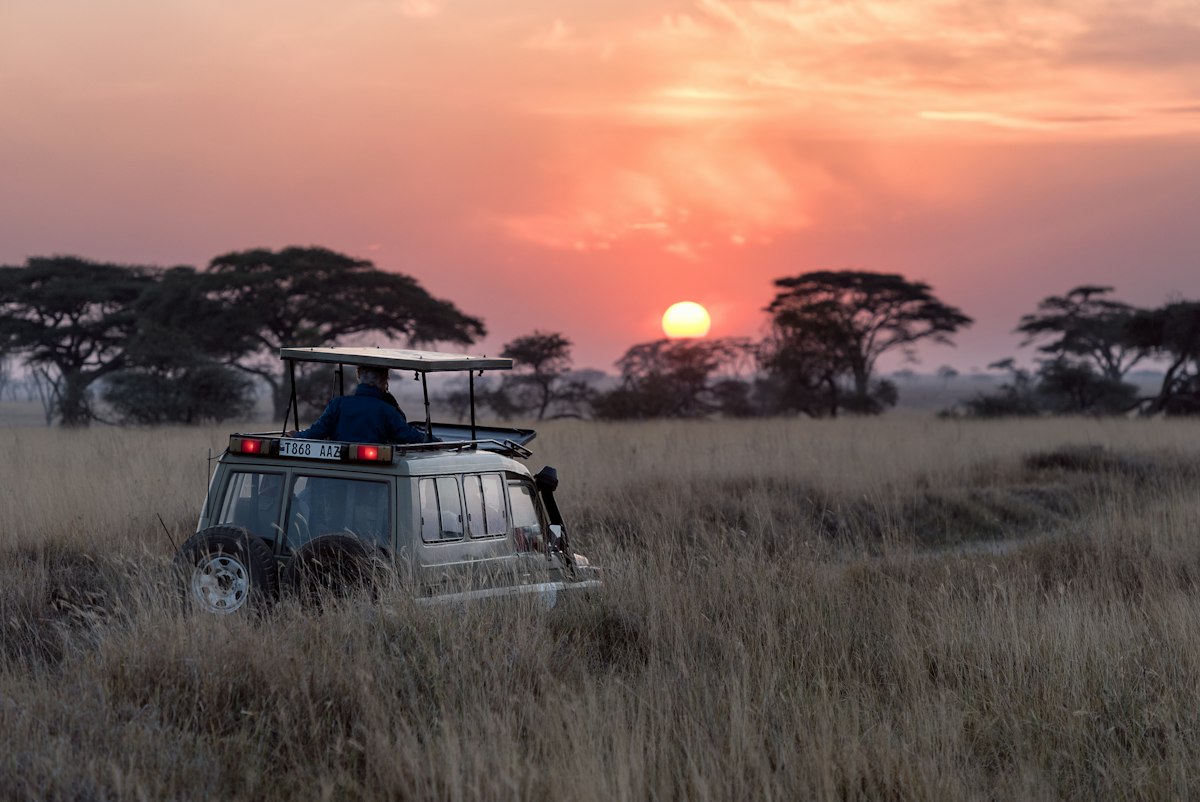
On safari, you travel in your operator's 4x4 with pop-up roof and driver-guide; self-drive is possible but rare. Driving from Arusha to Tarangire is about 2 hours, to the Ngorongoro rim about 3-4 hours and to central Serengeti about 7-8 hours. Light aircraft (Coastal Aviation, Auric Air and others) link Arusha, Serengeti airstrips and Zanzibar, with a soft-bag limit of about 15 kg. On Zanzibar, taxis are best, or the dala-dala minibuses for small fares.
What to eat in Tanzania
On safari, lodges serve buffets of international food. Elsewhere, try nyama choma (grilled goat or beef), mishkaki (skewers), ugali (maize porridge) and chips mayai (an omelette with chips). Zanzibar's food mixes African, Arab and Indian flavours: pilau rice with spices, biryani, urojo (Zanzibar mix, a tangy soup) and fresh octopus and lobster at Forodhani. Drink Kilimanjaro and Safari beers and Tanzanian coffee. Restaurant meals cost about US$10-25.
Best time to visit
June to October is the dry season and the best time for game viewing, when animals gather at water; it is also peak season. January to February is the calving season in the southern Serengeti, with predators following. The long rains in April and May bring heavy downpours and lower prices; some camps close. Zanzibar is hot and humid year-round, around 28-32°C, and at its best from June to October and December to February.
Month-by-month weather for Tanzania →
What a day costs
| Budget | Mid-range | Comfort | |
|---|---|---|---|
| Bed (per person, sharing a double) | US$50 | US$170 | US$600 |
| Food & drink | US$20 | US$40 | US$100 |
| Sights & tickets | US$60 | US$90 | US$150 |
| Local transport | US$70 | US$130 | US$250 |
| Total per person, per day | about US$200 | about US$430 | about US$1,100 |
Approximate 2026 prices in US dollars, the currency used for safaris, park fees and most hotels (the Tanzanian shilling is used for small purchases); figures average safari and Zanzibar days, and tip guides about US$15-25 per person per day.
Before you go
Common questions
How much does a safari in Tanzania cost?
A lot more than in many countries, mainly because of park fees. Budget camping safaris cost about US$200-280 per person per day, mid-range tented camps about US$350-550, and luxury lodges US$800 or more, all including park fees, vehicle, guide and meals. A private vehicle costs more than a shared group, but lets you choose your pace.
When can I see the Great Migration?
It moves all year round in a loop. From December to March, the herds are in the southern Serengeti and Ndutu, giving birth. From April to June they move west and north, crossing the Grumeti River around June. From July to October they are in the northern Serengeti at the Mara River crossings. Ask your operator to place you in the right area.
Do I need a visa and vaccinations?
Most visitors need a visa, about US$50 for a single entry, best applied for online through the official Tanzania e-visa portal. A yellow fever certificate is required if you arrive from or via a country with yellow fever risk. Malaria is present, so talk to a doctor about prevention, and use repellent at dusk.
Is Zanzibar safe?
Generally yes. Watch for pickpockets and touts in Stone Town, avoid walking alone on empty beaches at night, and use licensed taxis or ones arranged by your hotel. Zanzibar is mainly Muslim and conservative: cover up away from the beach, avoid public displays of affection, and respect Ramadan.
How this guide was made
Compiled by TonyPlan from official tourism, transport and attraction sources and on-the-ground travel knowledge. Prices are approximate for 2026 and change with season; anything we could not confirm is marked as approximate.
Some links on this page are partner links. If you book through them TonyPlan may earn a commission; the price you pay is the same. How we make money.