Home › Switzerland › How many days
How many days in Switzerland? 5 days: Zurich, Lucerne and the Jungfrau region by train
By Tony Panopoulos · travel-agency planner in Greece · Updated
Switzerland is expensive, but its trains, lake boats and mountain railways make it one of the easiest countries in Europe to travel without a car. Five days covers a classic triangle: Zurich for one day, Lucerne with a mountain excursion, and the Jungfrau region (Interlaken, Lauterbrunnen, Mürren, Grindelwald) for the Alps. Check the weather every morning and swap mountain days for town days when cloud is low: a summit in fog is an expensive view of nothing.
Short answer
Four days covers Zurich, Lucerne and two days in the Jungfrau region. Five days adds a buffer for bad weather in the mountains.
The 5-day plan, day by day
Day 1: Zurich
Morning. Walk Zurich's Old Town (Altstadt) on both sides of the Limmat: the Lindenhof viewpoint, the Fraumünster with stained-glass windows by Marc Chagall (small fee), and the twin towers of the Grossmünster, which you can climb for the view.
Afternoon. Walk along the Bahnhofstrasse to Lake Zurich and take a short lake boat ride (included in the Swiss Travel Pass), or visit the Swiss National Museum next to the main station.
Evening. Have dinner in the Niederdorf lanes, or try the city's most famous dish, Zürcher Geschnetzeltes (sliced veal in cream sauce with rösti), at a traditional guild-house restaurant.
Zurich's tap water and fountain water are excellent; refill a bottle instead of buying water, which is very expensive.
Day 2: Lucerne and Mount Pilatus
Morning. Take the train to Lucerne (about 45 minutes). Walk across the Chapel Bridge (Kapellbrücke), a covered wooden bridge from the 14th century with painted panels, and see the Lion Monument, a dying lion carved in the rock for the Swiss Guards killed in 1792.
Afternoon. Do the Golden Round Trip to Mount Pilatus (about CHF 100+, discounted with a pass): a boat across Lake Lucerne to Alpnachstad, the world's steepest cogwheel railway to 2,132 metres (May to November), and gondolas back down to Kriens.
Evening. Have dinner in Lucerne's old town and stay overnight, or continue to Interlaken.
In winter, the cogwheel railway is closed; the gondolas from Kriens still go up. Mount Rigi, 'the queen of the mountains', is an alternative on the other side of the lake.
Day 3: To Interlaken and Lauterbrunnen
Morning. Take the scenic Luzern-Interlaken Express (about 1h50) over the Brünig Pass, past lakes and waterfalls, to Interlaken, between Lake Thun and Lake Brienz.
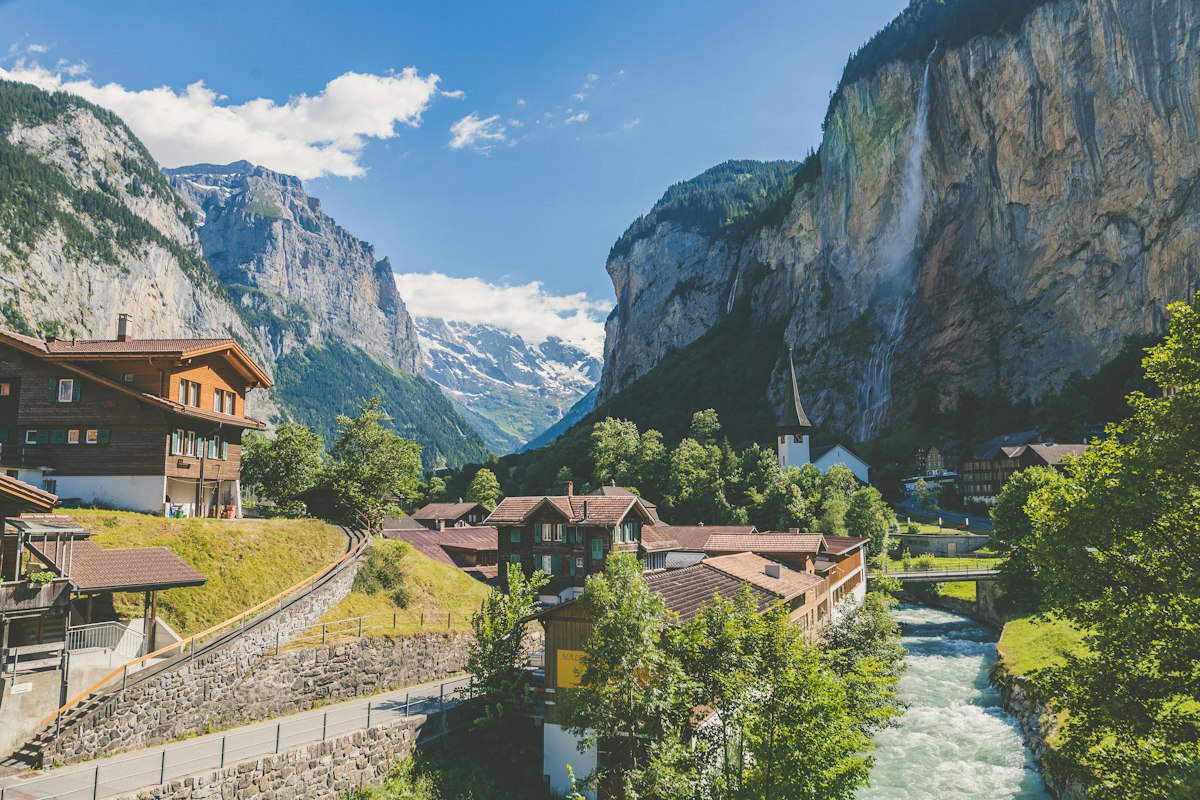
Afternoon. Take the train to Lauterbrunnen (about 20 minutes), a valley of 72 waterfalls between vertical cliffs. Walk to Staubbach Falls and Trümmelbach Falls, glacial waterfalls inside the mountain (small fee).
Evening. Stay in Lauterbrunnen, Wengen or Mürren for the full mountain experience; the villages above the valley are car-free.
Interlaken is a practical base, but staying up in the villages (Wengen, Mürren, Grindelwald) gives sunsets and mornings in the mountains.
Day 4: Mürren and the Schilthorn (or Grindelwald First)
Morning. Take the cable car from Lauterbrunnen to Grütschalp and the little train to Mürren, a car-free village on a cliff opposite the Eiger, Mönch and Jungfrau. Continue by cable car to the Schilthorn (2,970 m), with a revolving restaurant and the James Bond exhibition from On Her Majesty's Secret Service.
Afternoon. Walk down from Mürren to Gimmelwald on easy paths, or, if you prefer, go to Grindelwald First for the cliff walk, a mountain-top lake (Bachalpsee) and the downhill 'First Flyer' zipline.
Evening. Dinner in a mountain village: fondue or raclette.
Many lifts in the region close for maintenance in April-May and November; check the dates.
Day 5: Jungfraujoch, the 'Top of Europe'
Morning. Take the trains via Kleine Scheidegg or the Eiger Express gondola from Grindelwald Terminal to the Jungfraujoch (3,454 m), the highest railway station in Europe (about CHF 200+ return from Interlaken, with discounts for pass holders). See the Aletsch Glacier, the Ice Palace and the Sphinx observation terrace.
Afternoon. Return to Interlaken and take a boat on Lake Brienz (turquoise water; included with a Swiss Travel Pass), or relax.
Evening. Take the train back to Zurich (about 2 hours) for your flight, or stay one more night.
The Jungfraujoch is only worth it on a clear day. Check the live webcams before buying tickets. At 3,454 metres, move slowly.
Only have 4 days?
With 4 days, combine Zurich and Lucerne in two days and spend two days in the Jungfrau region; skip either the Schilthorn or the Jungfraujoch.
Got extra days?
With more time, go to Zermatt for the Matterhorn and the Gornergrat railway, ride the Glacier Express or Bernina Express, or visit Bern, the capital, and Lake Geneva with Montreux and the Château de Chillon.
Where to stay in Switzerland
| Budget | Area | Why | Typical double/night |
|---|---|---|---|
| Budget | Interlaken hostels / Lauterbrunnen campsites | The cheapest beds in the mountains. | CHF 120-200 |
| Mid-range | Lucerne old town | Lake views, the station and boats on the doorstep. | CHF 220-380 |
| Mid-range | Wengen / Mürren / Grindelwald | Mountain villages with Eiger and Jungfrau views. | CHF 220-400 |
| Comfort | Zurich lake hotels / mountain grand hotels | Historic luxury hotels with lake or Alps views. | CHF 500-1,200 |
Getting around
Use the trains, which are punctual and scenic, plus lake boats, buses and mountain railways. The Swiss Travel Pass (3, 4, 6, 8 or 15 days) covers trains, boats and city transport and gives discounts on many mountain railways; the Half Fare Card halves most fares. Do the maths for your route: for this plan, a 4-day Swiss Travel Pass or a Half Fare Card usually pays off. Zurich Airport has its own station, 10 minutes from the city centre.
What to eat in Switzerland
Swiss food is mountain food: fondue (melted cheese with bread) and raclette (melted cheese scraped over potatoes), rösti (crispy grated potato), Älplermagronen (alpine macaroni with cheese, potatoes and apple sauce) and Zürcher Geschnetzeltes. Buy chocolate from Sprüngli, Läderach or a supermarket (Coop and Migros have very good cheap brands). Eating out is expensive: a simple main course costs CHF 25-40. Supermarket picnics save a lot.
Best time to visit
June to September for hiking, open mountain railways and lake swimming, with highs of 20-26°C in the valleys. December to April for skiing and snowy villages. Spring and late autumn are quiet, but many mountain lifts close for maintenance. Mountains can be cold at any time: bring warm layers even in summer.
Month-by-month weather for Switzerland →
What a day costs
| Budget | Mid-range | Comfort | |
|---|---|---|---|
| Bed (per person, sharing a double) | CHF 70 | CHF 150 | CHF 350 |
| Food & drink | CHF 40 | CHF 80 | CHF 160 |
| Mountain excursions & sights | CHF 30 | CHF 100 | CHF 200 |
| Transport (with pass) | CHF 40 | CHF 60 | CHF 100 |
| Total per person, per day | about CHF 180 | about CHF 390 | about CHF 810 |
Approximate 2026 prices in Swiss francs (roughly CHF 0.95 to €1). Mountain railway prices vary greatly by season; local tourist taxes are added per person per night.
Before you go
Common questions
Is the Swiss Travel Pass worth it?
For a train-based trip with lake boats and several mountain excursions, often yes. For a slow trip with few journeys, the Half Fare Card is cheaper. Calculate your route with the SBB app before buying.
Jungfraujoch, Schilthorn or Pilatus?
Jungfraujoch for the glacier and the altitude (most expensive); Schilthorn for the best panorama of the Eiger, Mönch and Jungfrau; Pilatus for an easy, spectacular trip from Lucerne. On a budget, choose one.
Is Switzerland very expensive?
Yes, among the most expensive countries in the world. Save with a rail pass, supermarket food, free hikes and tap water.
Can I visit without a car?
Easily. Trains, buses and boats reach almost every village, and some mountain villages are car-free.
What if the weather is bad?
Swap days: visit Zurich, Lucerne's old town, museums or lake towns on cloudy days, and keep the summits for clear mornings.
How this guide was made
Written by hand, without AI, from experience planning Switzerland trips. Prices are approximate for 2026 in Swiss francs; confirm on the official SBB, Jungfrau Railways, Schilthorn, Pilatus and Swiss Travel System websites before booking.
Some links on this page are partner links. If you book through them TonyPlan may earn a commission; the price you pay is the same. How we make money.