How many days in Jeddah? 3 days, from Al-Balad's coral houses to the Red Sea reefs
By Tony Panopoulos · travel-agency planner in Greece · Updated
For centuries Jeddah was the port where pilgrims landed for Mecca, and that left it the most relaxed and international city in Saudi Arabia. Give it three days: one in Al-Balad, the old town of coral-stone houses with wooden balconies, one along the 30 km Corniche and its museums, and one on the Red Sea, where the reefs begin a few minutes offshore. The rule that matters: the city lives at night, so rest in the afternoon heat and go out after sunset.
Short answer
Two days covers Al-Balad and the Corniche with King Fahd's Fountain. The third day is for the sea: a snorkelling or diving boat from Obhur, or a beach club north of the city.
The 3-day plan, day by day
Day 1: Al-Balad, the old town
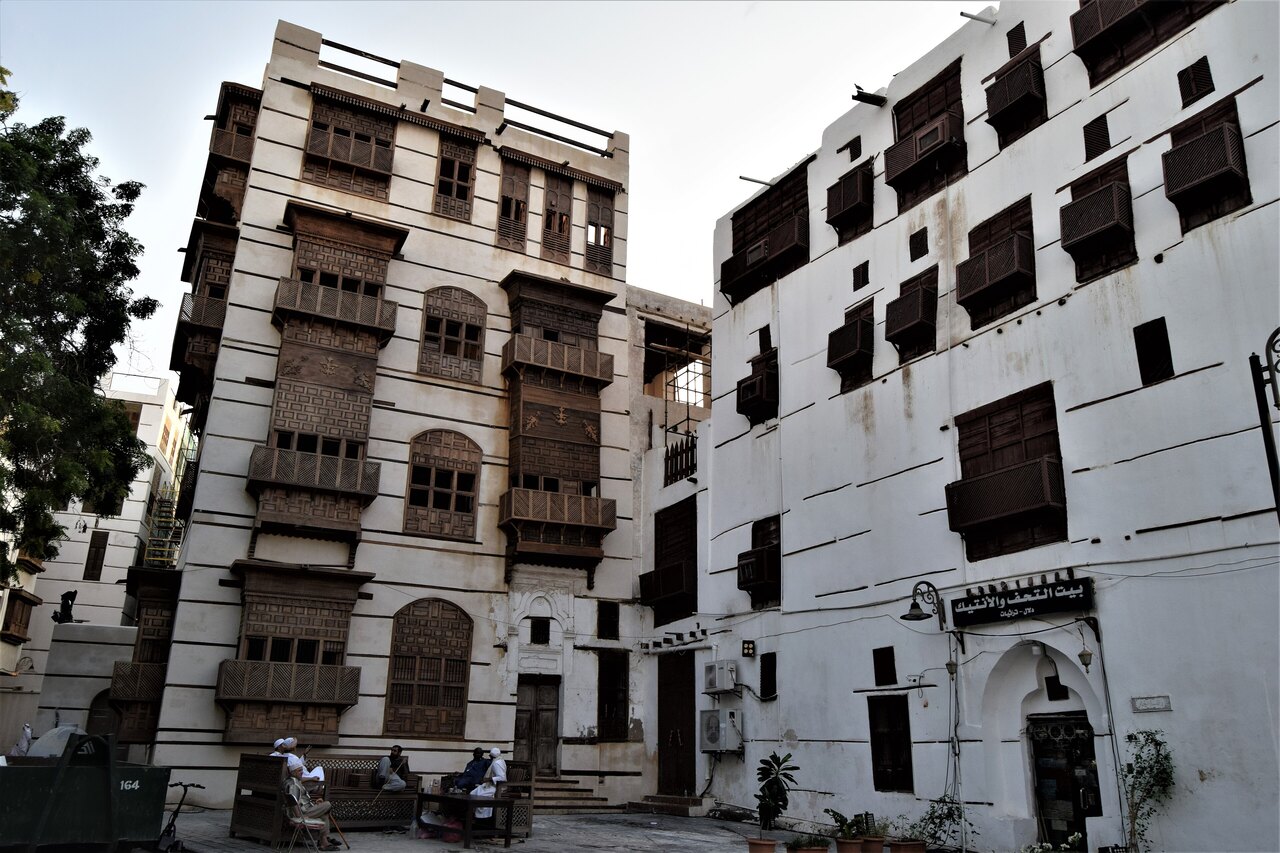
Morning. Start at Bab Makkah, the old gate on the road to Mecca, and walk into Al-Balad, a UNESCO World Heritage Site since 2014. Its tall houses are built of coral blocks from the Red Sea, with rawasheen, carved wooden window screens that let the breeze in. Visit Beit Nassif on Al-Alawi Street, the merchant house where King Abdulaziz stayed in 1925 (check opening hours locally).
Afternoon. Walk the length of Souq Al-Alawi, the old market street running north-south, with spice, perfume, oud and textile shops, and see the minaret of the Al-Shafi'i Mosque, one of the oldest in the city. Rest through the hottest hours: many shops close from about 12:00-16:30 and briefly at each prayer time.
Evening. Al-Balad wakes up after sunset (about 18:00-18:30). Drink sweet mint tea at a café on a restored square, eat mutabbaq (stuffed fried pastry) from a street stall for SAR 10-15, and look for cultural events in the restored houses during the Jeddah Historic District season.
Shops and cafés close for about 20-30 minutes at each of the five prayer times. Check a prayer-time app each morning and plan coffee breaks around them.
Day 2: The Corniche, sculptures and King Fahd's Fountain
Morning. Visit the Al-Rahma Mosque, the 'floating mosque' built on stilts over the sea on the Corniche (exterior viewing for non-Muslims). Continue to the Tayebat City Museum (about SAR 50), a large private museum in Hejazi style with sections on the region's history, coins, costumes and Islamic manuscripts.
Afternoon. Head to the Jeddah Waterfront in the central Corniche, with landscaped promenades, a fishing pier, beaches and children's play areas. Jeddah is known for its open-air sculptures from the 1970s and 1980s: see works by Henry Moore, Joan Miró and Alexander Calder in the Corniche Sculpture Park area.
Evening. At sunset, watch King Fahd's Fountain, which shoots water about 300 metres into the air, one of the tallest fountains in the world, best seen from the waterfront promenade at Al-Hamra. Have dinner at one of the cafés along the Corniche or in Al-Hamra for SAR 60-120.
Distances along the Corniche are long: use a ride-hailing app like Uber or Careem between stops. A 10-15 km ride typically costs SAR 25-45.
Day 3: Red Sea day at Obhur
Morning. Drive 30-40 minutes north to Obhur, the creek where Jeddah families keep their boats. Join a snorkelling or diving trip (about SAR 250-500 per person with equipment) to the reefs a short boat ride offshore, with hard corals, parrotfish and, if you are lucky, turtles and dolphins. Divers can visit the Staphonos wreck, a cargo ship sunk in the 1970s.
Afternoon. Spend the afternoon at a beach club in North Obhur, where day passes cost about SAR 150-400 and mixed beachwear is accepted inside the club. Public beaches have more conservative dress norms.
Evening. Return to the city for seafood at the Al-Bander fish market area near the old port, where you choose your fish on ice and have it grilled or fried, about SAR 60-100 per person. For shops and a cinema, Red Sea Mall is the alternative.
Bring reef shoes, plenty of sunscreen and a rash vest. The Red Sea sun is intense even in winter, and sea urchins are common near the reef edges.
Only have 2 days?
With 2 days, do Al-Balad on Day 1 and the Corniche with the floating mosque and King Fahd's Fountain on Day 2. You lose the Red Sea, which is a real pity in this city.
Got extra days?
Extra days go to Taif, the mountain city about 2-3 hours east at 1,800 metres, known for rose farms in spring and cooler air, or further north to AlUla (about 1h20 by plane) for the Nabataean tombs of Hegra. Muslims can travel to Mecca for Umrah (about 1 hour by the Haramain high-speed train).
Where to stay in Jeddah
| Budget | Area | Why | Typical double/night |
|---|---|---|---|
| Budget | Al-Balad / Al-Baghdadiyah | Simple hotels near the old town, close to the fish market and the Corniche. | SAR 200-350 |
| Mid-range | Al-Hamra | Central location on the Corniche, near King Fahd's Fountain, with many international chains. | SAR 400-750 |
| Mid-range | Al-Rawdah / Tahlia Street | Shopping and restaurant district, popular with business travellers. | SAR 400-700 |
| Comfort | North Corniche / Obhur | Sea-view resorts with private beaches, 20-30 minutes from the centre. | SAR 900-2,000 |
Getting around
Jeddah is built for cars. Use Uber or Careem: most rides in the city cost SAR 20-50, and taxis from King Abdulaziz International Airport to Al-Hamra take about 30-40 minutes for SAR 70-110. The Haramain high-speed railway runs from Jeddah's Al-Sulaimaniyah station and the airport station to Mecca (about 35 minutes, Muslims only beyond the boundary) and Medina (about 2 hours); tickets from about SAR 50-150. Walking is pleasant only in Al-Balad and along the Corniche after dark. Car hire is easy with an international licence.
What to eat in Jeddah
Jeddah's food reflects its port history: Yemeni, Indonesian, Indian and Egyptian influences sit alongside Hejazi cooking. Try saleeg, rice cooked in milk with chicken, and mandi or kabsa, spiced rice with lamb or chicken, about SAR 30-60 for a plate to share. For street food, the local chain Al Baik sells famous fried chicken and shrimp for SAR 15-25. In Al-Balad, eat foul (stewed fava beans) with fresh bread for breakfast, and balila (spiced chickpeas) in the evening. Fish is excellent: try hamour (grouper). Alcohol is not available in Saudi Arabia; drink fresh juices, Saudi coffee with cardamom and dates, or karak tea.
Best time to visit
November to March, with highs of 28-32°C and pleasant evenings. From May to September Jeddah is extremely hot and humid, with highs above 38°C and humidity often above 70%. The city hosts the Jeddah Season festival and the Formula 1 Saudi Arabian Grand Prix on the Corniche circuit (usually in spring), when hotels fill and prices rise. During Ramadan, restaurants are closed by day and the city comes alive at night.
Month-by-month weather for Jeddah →
What a day costs
| Budget | Mid-range | Comfort | |
|---|---|---|---|
| Bed (per person, sharing a double) | SAR 120 | SAR 280 | SAR 700 |
| Food & drink | SAR 60 | SAR 150 | SAR 350 |
| Sights & tickets | SAR 30 | SAR 150 | SAR 400 |
| Local transport | SAR 40 | SAR 80 | SAR 200 |
| Total per person, per day | about SAR 250 | about SAR 660 | about SAR 1,650 |
Approximate 2026 prices in Saudi riyals (SAR); hotels add 15% VAT and a municipality fee of roughly 2.5-5%, so check whether a quoted rate includes tax.
Before you go
Common questions
What should I wear in Jeddah?
Saudi Arabia relaxed its dress rules for tourists in 2019. Women do not have to wear an abaya or cover their hair, but both men and women should cover shoulders and knees in public, and clothes should not be tight or see-through. Inside mosques, women cover their hair. Swimwear is fine at beach clubs and resorts, but not on public beaches or in the city.
Can non-Muslims visit Jeddah and Mecca?
Non-Muslims can visit Jeddah freely with a tourist e-visa, which many nationalities can get online in minutes. Mecca and the central area of Medina are open only to Muslims; road signs mark the boundary, and the Haramain train beyond Jeddah is for Muslims only to Mecca. Jeddah itself has many mosques, some open to visitors outside prayer times.
Is Jeddah safe for tourists?
Yes. Jeddah has low crime and a large expatriate population. The main dangers are the traffic, which is fast and aggressive, and the heat. Follow local laws carefully: no alcohol, no drugs, no public displays of affection, and do not photograph people, especially women, without permission, or government buildings and military sites.
How long can I stay on a Saudi tourist visa?
The Saudi e-visa for tourism is usually a one-year multiple-entry visa allowing stays of up to 90 days in total, available online for many nationalities at around SAR 480-535 including mandatory health insurance. It does not allow work or Hajj; Umrah is permitted for Muslims outside the Hajj season. Check the official Visit Saudi website for current rules.
How this guide was made
Compiled by TonyPlan from official tourism, transport and attraction sources and on-the-ground travel knowledge. Prices are approximate for 2026 and change with season; anything we could not confirm is marked as approximate.
Some links on this page are partner links. If you book through them TonyPlan may earn a commission; the price you pay is the same. How we make money.