Home › Albania › How many days
How many days in Albania? 6 days from Tirana to the Albanian Riviera
By Tony Panopoulos · travel-agency planner in Greece · Updated
Albania was closed to the world for almost half a century under Enver Hoxha's communist regime, and it is now one of Europe's best-value destinations: Ottoman towns on the UNESCO list, Greek and Roman ruins, mountains, and beaches on the Ionian Sea that rival Greece's. Six days fits a north-to-south route: Tirana, Berat, Gjirokastër, the Blue Eye spring, Butrint and the beaches of Ksamil and the Riviera. Distances are short but roads are slow, and buses (furgons) do not always run to a timetable.
Short answer
Four days covers Tirana, Berat, Gjirokastër and Ksamil at a quick pace. Six days lets you add Butrint, the Riviera and beach time.
The 6-day plan, day by day
Day 1: Tirana
Morning. Start on Skanderbeg Square, with the Et'hem Bey Mosque (1823), the clock tower and the National History Museum's socialist mosaic. Visit Bunk'Art 2, a nuclear bunker turned museum of the communist secret police (a few hundred lek).
Afternoon. Take the Dajti Ekspres cable car up Mount Dajti for views over the city, or visit Bunk'Art 1, Hoxha's vast underground bunker on the edge of town. See the Pyramid of Tirana, a former Hoxha museum now covered in climbable steps and a tech centre.
Evening. Have dinner and drinks in Blloku, the district once reserved for the communist elite, now Tirana's liveliest bar and restaurant area.
Tirana's colourful façades were painted in the early 2000s on the initiative of mayor (later prime minister) Edi Rama, an artist, to brighten the post-communist city.
Day 2: Berat
Morning. Take the bus or drive about 2 hours to Berat, the 'city of a thousand windows', where Ottoman houses rise in tiers up the hillside along the Osum river (UNESCO, with Gjirokastër).
Afternoon. Climb to the Berat Castle (Kalaja), still inhabited, with Byzantine churches and the Onufri Museum of icons. Walk through the Mangalem and Gorica quarters, linked by an old stone bridge.
Evening. Stay in a guesthouse in an old Ottoman house and have dinner in Mangalem.
Visit a winery in the Berat area for local Shesh i Zi red wine.
Day 3: Gjirokastër
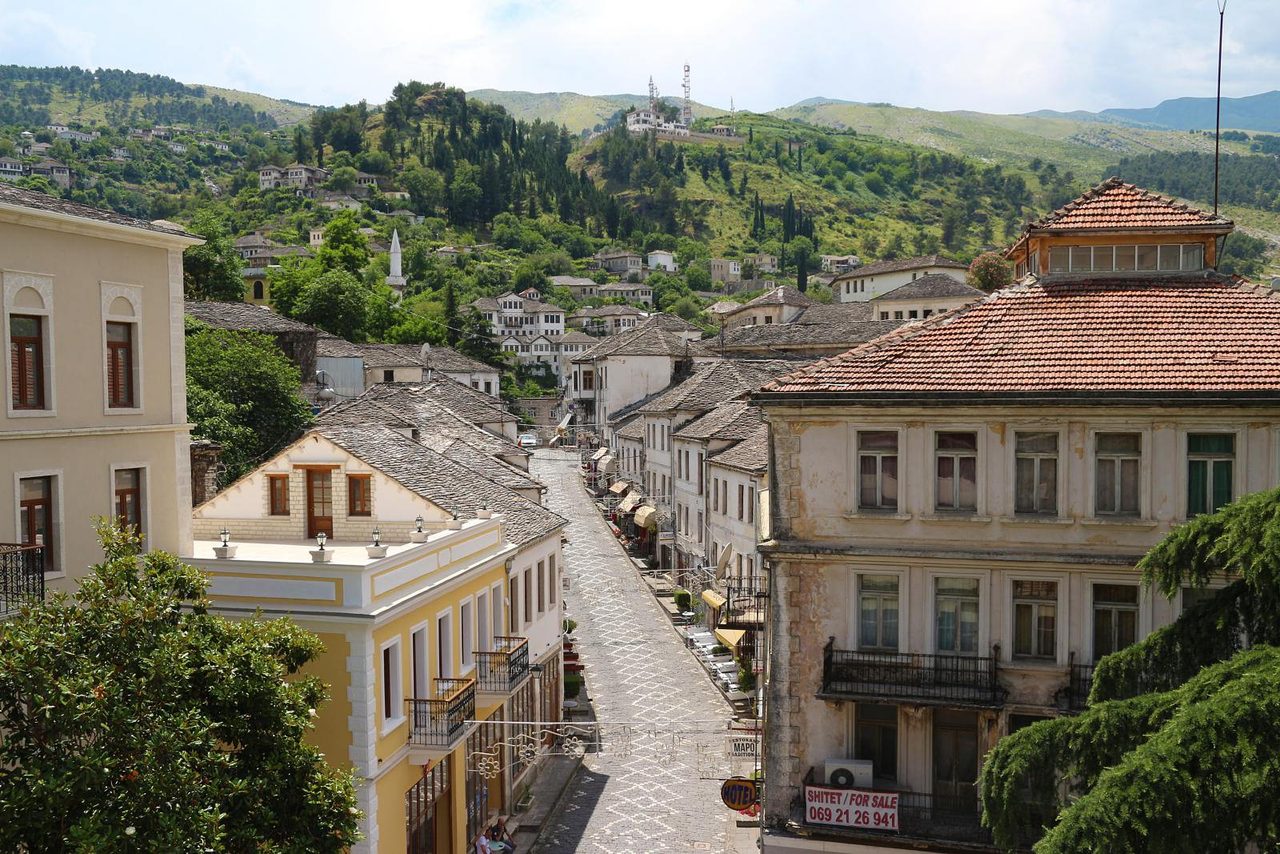
Morning. Travel about 3-3.5 hours south to Gjirokastër, the 'stone city', with houses roofed in grey stone slabs, birthplace of Enver Hoxha and the writer Ismail Kadare.
Afternoon. Visit the Gjirokastër Castle (with a captured US Air Force jet and a museum of weapons), the Zekate House, a fortified 19th-century Ottoman mansion, and the Cold War tunnel, a secret bunker under the city.
Evening. Have dinner in the Old Bazaar and try qifqi, rice balls with herbs, a local speciality.
The bazaar's steep cobbles are slippery; wear shoes with grip.
Day 4: The Blue Eye and Butrint
Morning. Drive about 40 minutes to the Blue Eye (Syri i Kaltër), a spring where water rises from more than 50 metres down in a pool of deep blue surrounded by forest. Swimming is no longer allowed.
Afternoon. Continue to Butrint (UNESCO, about 1,000 lek), an ancient city on a lagoon near the Greek border, with a Greek theatre, a Roman forum, a Byzantine baptistery with floor mosaics (often covered with sand to protect them) and a Venetian castle.
Evening. Stay in Ksamil and watch the sunset over the small islands offshore.
Butrint is very hot in summer; visit in the late afternoon or early morning.
Day 5: Ksamil and the Riviera
Morning. Swim at Ksamil, with white sand and turquoise water; small boats and kayaks go to the islands just offshore.
Afternoon. Drive north along the Albanian Riviera to Himarë and Dhërmi, with beaches below the mountains and the coves of Gjipe (reached by a canyon walk).
Evening. Have dinner in Himarë by the sea and sleep there or in Dhërmi.
In July and August, Ksamil's beaches are crowded and lined with sunbeds (about 1,000-3,000 lek for two). June and September are calmer.
Day 6: Llogara Pass and back to Tirana
Morning. Drive over the Llogara Pass (1,027 m), with paragliding and a view down the Riviera, and through Vlorë, where Albania's independence was declared in 1912.
Afternoon. Stop in Durrës for the Roman amphitheatre, one of the largest in the Balkans, before returning to Tirana.
Evening. Last dinner in Tirana's Blloku or at a traditional restaurant serving tavë kosi.
If you are flying out, Tirana airport is only 25 minutes from Durrës.
Only have 4 days?
With 4 days, do Tirana, Berat and Gjirokastër quickly, then end in Ksamil (or start in Saranda by ferry from Corfu and drive north).
Got extra days?
With more time, go north to the Accursed Mountains for the Theth to Valbona hike and the Komani Lake ferry, or visit Korçë and Lake Ohrid.
Where to stay in Albania
| Budget | Area | Why | Typical double/night |
|---|---|---|---|
| Budget | Guesthouses in Berat and Gjirokastër | Family-run, often in historic houses, with breakfast. | 3,500-6,000 lek |
| Mid-range | Tirana centre / Blloku | Restaurants, nightlife, central for buses. | 7,000-12,000 lek |
| Mid-range | Ksamil / Himarë | Beach hotels and apartments. | 7,000-14,000 lek |
| Comfort | Riviera resorts / boutique hotels | Sea-view resorts in Dhërmi and Ksamil. | 18,000-40,000 lek |
Getting around
Furgons (minibuses) and buses connect most towns cheaply, but timetables are informal; ask locally. Renting a car gives the most freedom; roads have improved, but driving can be aggressive and mountain roads are slow. Tirana airport is the main gateway; ferries link Saranda with Corfu (about 30-70 minutes).
What to eat in Albania
Albanian food is fresh and generous: tavë kosi (baked lamb with yoghurt and egg, the national dish), byrek (filo pie with cheese, spinach or meat, for breakfast), fërgesë (peppers, tomatoes and cottage cheese), grilled lamb, fresh fish on the coast and the stuffed vegetables and qifqi of Gjirokastër. Drink raki, offered as a sign of hospitality, and local beers such as Korça. A full meal costs 1,000-2,000 lek (about €10-20).
Best time to visit
May, June and September are best, with highs of 25-30°C and warm sea. July and August are hot (inland above 35°C) and the Riviera is very busy with domestic and Kosovar visitors. Spring is green and good for hiking.
Month-by-month weather for Albania →
What a day costs
| Budget | Mid-range | Comfort | |
|---|---|---|---|
| Bed (per person, sharing a double) | 2,000 lek | 4,500 lek | 12,000 lek |
| Food & drink | 1,500 lek | 3,000 lek | 6,000 lek |
| Sights & activities | 500 lek | 1,500 lek | 4,000 lek |
| Transport (furgons / car share) | 800 lek | 2,500 lek | 5,000 lek |
| Total per person, per day | about 4,800 lek | about 11,500 lek | about 27,000 lek |
Approximate 2026 prices in Albanian lek (very roughly 100 lek to €1). Euros are widely accepted on the coast, but usually at a worse rate than paying in lek.
Before you go
Common questions
Is Albania safe for tourists?
Yes. Albanians are famously hospitable. The main risks are road traffic and driving at night on unlit mountain roads.
Should I pay in lek or euros?
In lek where possible; prices in euros are often rounded up. ATMs are common in towns.
Can I visit Albania from Corfu?
Yes: ferries run from Corfu to Saranda (about 30-70 minutes). Butrint and Ksamil are 20 minutes from Saranda.
Do I need a car?
Not necessarily, but it makes the route much easier, especially the Riviera and the Blue Eye.
Is Albania good for families?
Yes: calm beaches, friendly people and low prices. Long drives and steep stone towns need planning with young children.
Which beach is best?
Ksamil for turquoise water and islands, Dhërmi and Drymades for long beaches with mountains, Gjipe for a wild cove reached on foot.
Is English spoken?
In hotels and by younger people, yes. Italian and Greek are also widely understood.
How this guide was made
Written by hand, without AI, from experience planning Balkan trips. Prices are approximate for 2026 in lek; confirm on the official Albanian tourism, Butrint National Park and ferry operators' websites before booking.
Some links on this page are partner links. If you book through them TonyPlan may earn a commission; the price you pay is the same. How we make money.