Home › Sarajevo › How many days
How many days in Sarajevo? 3 days: Baščaršija, the siege story and the Olympic mountain
By Tony Panopoulos · travel-agency planner in Greece · Updated
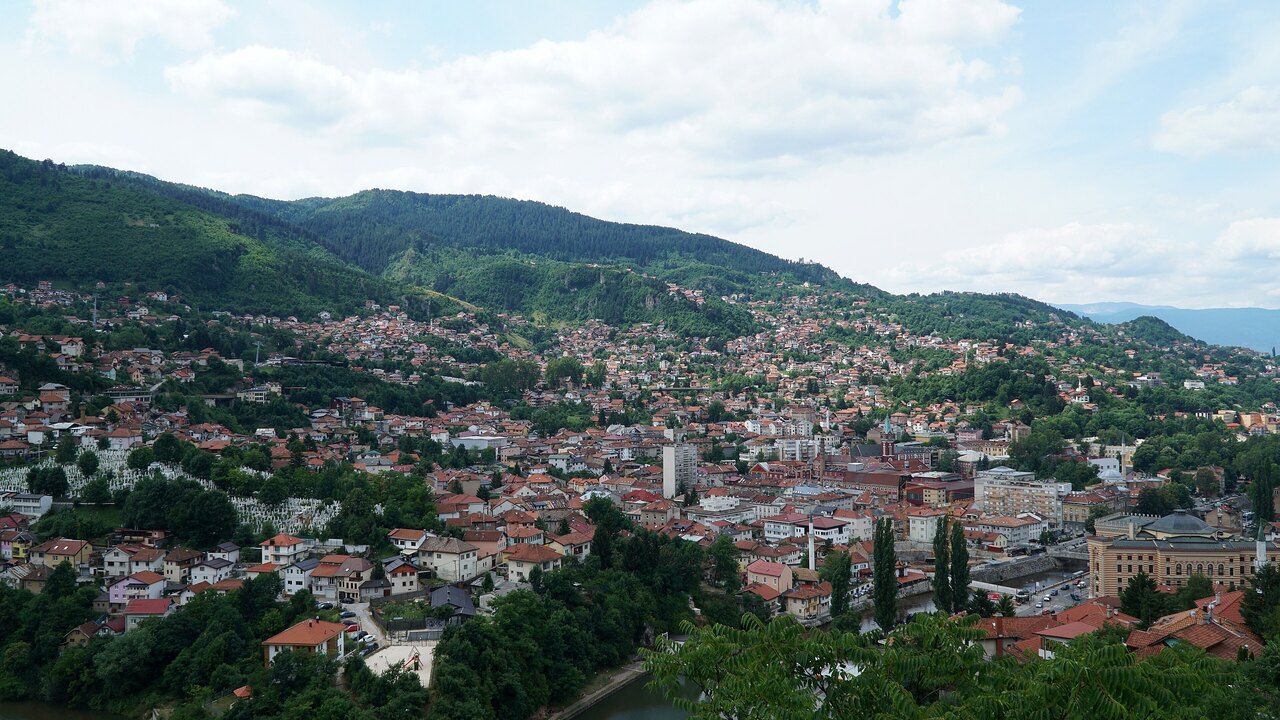
In one walk down Ferhadija street you pass from an Ottoman bazaar into Austro-Hungarian avenues, and within a few hundred metres there are mosques, a Catholic cathedral, an Orthodox church and a synagogue. Sarajevo also carries the memory of the 1992-1996 siege, the longest of a capital city in modern warfare. Three days is right: one for the old town, one for the 20th century, and one for the mountains above the city.
Short answer
Two days covers Baščaršija, the Latin Bridge, the main museums and the Tunnel of Hope. The third day adds Trebević, the Olympic bobsled track and Vrelo Bosne.
The 3-day plan, day by day
Day 1: Baščaršija and the old town
Morning. Start at the Sebilj, the wooden fountain in the heart of Baščaršija, the Ottoman bazaar founded in the 15th century. Walk the lanes of coppersmiths on Kazandžiluk street, then visit the Gazi Husrev-beg Mosque (1531; about KM 5), the finest Ottoman building in the Balkans, and the covered market of Bezistan next door.
Afternoon. Walk west on Ferhadija and find the 'Sarajevo Meeting of Cultures' line on the pavement, where Ottoman buildings give way to Austro-Hungarian ones. Within 5 minutes you pass the Sacred Heart Cathedral, the Old Orthodox Church and, across the river, the Ashkenazi Synagogue. Then see Vijećnica, the striped neo-Moorish City Hall, burned in 1992 with the national library and restored in 2014 (about KM 10).
Evening. Climb 15-20 minutes to the Yellow Fortress (Žuta tabija) for sunset over the city, when the call to prayer echoes from dozens of minarets. Then eat ćevapi in Baščaršija: ten small grilled sausages in somun bread with onions cost about KM 10-12 at Željo or Hodžić.
During Ramadan, a cannon is fired from the Yellow Fortress at sunset to mark the end of the daily fast; locals gather to watch.
Day 2: 1914, the siege and the Tunnel of Hope
Morning. Stand at the Latin Bridge, where Gavrilo Princip shot Archduke Franz Ferdinand on 28 June 1914, the spark of the First World War. The small Museum Sarajevo 1878-1918 on the corner (about KM 5) tells the story. Then visit the War Childhood Museum (about KM 10-15), which shows the siege through the toys, letters and diaries of children who lived through it.
Afternoon. Take a tour or taxi (about 30 minutes) to the Tunnel of Hope museum near the airport (about KM 20), where an 800-metre tunnel under the runway was the city's only link to the outside world during the siege. You can walk through about 25 metres of the original tunnel. On the way, look for Sarajevo Roses: mortar scars filled with red resin in the pavements.
Evening. Visit the Gallery 11/07/95 (about KM 15), a sobering exhibition on the Srebrenica genocide, open until about 22:00. Then have a quiet dinner of begova čorba (bey's soup) and klepe (Bosnian dumplings) at a traditional restaurant (KM 15-25).
A guided siege tour (about KM 60-80 including the Tunnel) given by locals who lived through it is far more powerful than visiting alone.
Day 3: Trebević, the bobsled track and Vrelo Bosne
Morning. Ride the Trebević cable car, rebuilt in 2018 after the war destroyed it, from near the old town up to about 1,160 metres in about 10 minutes (about KM 20-30 return for visitors). Walk 20 minutes through pine forest to the 1984 Winter Olympics bobsled track, a concrete ruin covered in graffiti that was used as a front-line position during the war.
Afternoon. Back in town, take tram 3 west to Ilidža (about 30 minutes) and walk or ride a horse-drawn carriage down a 3 km avenue of plane trees to Vrelo Bosne, a park of streams and wooden bridges at the source of the river Bosna (entry about KM 2-5).
Evening. Have Bosnian coffee served in a copper džezva with a sugar cube and rahat lokum, then eat burek (meat pie) or sirnica (cheese pie) at a buregdžinica, about KM 4-6 a portion. Finish with a beer at the Sarajevo Brewery (Sarajevska pivara), on the site of the 1864 brewery.
Do not walk off marked paths in the hills around Sarajevo: some areas still contain landmines from the war. Stay on trails and roads.
Only have 2 days?
With 2 days, do Day 1 and Day 2 as written and fit the Trebević cable car into the late afternoon of Day 1 if the weather is clear. You lose Vrelo Bosne.
Got extra days?
A 4th day suits Mostar and its Old Bridge (about 2 hours by train along the Neretva valley), often combined with the Kravica waterfalls and Počitelj. Jahorina and Bjelašnica, the Olympic ski mountains, are 30-45 minutes away for skiing in winter and hiking in summer.
Where to stay in Sarajevo
| Budget | Area | Why | Typical double/night |
|---|---|---|---|
| Budget | Baščaršija hostels | Cheap rooms in the heart of the old town. | KM 60-100 |
| Mid-range | Baščaršija / Old Town | Walk to everything; small hotels in old houses with Ottoman-style rooms. | KM 120-200 |
| Mid-range | Marijin Dvor / centre | Austro-Hungarian centre, quieter, close to the trams. | KM 120-190 |
| Comfort | City centre hotels | Historic and international hotels, such as the restored Hotel Europe. | KM 250-450 |
Getting around
Central Sarajevo is a long, narrow valley, and the old town is walkable: Baščaršija to Marijin Dvor is about 25 minutes. Trams run east to west along the valley; a single ticket costs about KM 1.80 from a kiosk (a little more from the driver), and must be stamped. Taxis are cheap and metered; use the official companies or apps. Sarajevo International Airport is 12 km from the centre: about 20-30 minutes and KM 25-35 by taxi, or a shuttle bus to the centre.
What to eat in Sarajevo
Sarajevo food is Ottoman-influenced comfort food. Ćevapi are the city's pride; order 'pola' (half, 5 pieces) or 'deset' (10) with onions and kajmak (clotted cream). Burek is filled only with meat in Bosnia; with cheese it is sirnica, with spinach zeljanica and with potato krompiruša. Try sogan dolma (stuffed onions), japrak (stuffed vine leaves) and tufahija, a poached apple filled with walnuts and topped with cream. Baklava costs about KM 2-3 a piece. Bosnian coffee is a ritual; do not call it Turkish. A full meal costs KM 15-30 per person.
Best time to visit
May to June and September to October, with highs of 18-25°C. July and August are hot (30°C+), and the Sarajevo Film Festival in August fills hotels. Winters are cold and snowy, with smog in the valley on still days, but good for skiing on Jahorina and Bjelašnica. During Ramadan, the old town is festive in the evenings.
Month-by-month weather for Sarajevo →
What a day costs
| Budget | Mid-range | Comfort | |
|---|---|---|---|
| Bed (per person, sharing a double) | KM 35 | KM 80 | KM 170 |
| Food & drink | KM 25 | KM 50 | KM 100 |
| Sights & tickets | KM 10 | KM 30 | KM 70 |
| Local transport | KM 4 | KM 10 | KM 30 |
| Total per person, per day | about KM 74 | about KM 170 | about KM 370 |
Approximate 2026 prices in Bosnia and Herzegovina convertible marks (KM 1.96 = €1, a fixed rate; euros are often accepted). Hotels add a tourist tax of about KM 2-4 per person per night.
Before you go
Common questions
Is Sarajevo safe?
Yes. Sarajevo is a safe, friendly city with low street crime; the main risks are pickpockets in Baščaršija and on crowded trams. The war ended in 1995. Landmines remain in some rural and mountain areas, so stick to marked paths and roads when hiking. People talk openly about the war, but follow their lead and be sensitive.
Can I visit Mostar as a day trip?
Yes. Trains between Sarajevo and Mostar take about 2 hours along a spectacular route through the Neretva canyon, with two or so trains a day; buses take about 2.5 hours. Tours often add the Kravica waterfalls, Blagaj dervish house and Počitelj. Mostar's Old Bridge, rebuilt in 2004, is busiest from 11:00 to 16:00.
What currency is used in Sarajevo?
The convertible mark (KM or BAM), pegged at about 1.96 to the euro. Euros are widely accepted in hotels and tourist shops but change is given in marks, often at a poor rate. Cards work in most hotels and restaurants, but cash is still needed for ćevapi shops, markets and trams. ATMs are everywhere in the centre.
Can I drink alcohol in Sarajevo?
Yes. Although Sarajevo has a Muslim majority, it is a secular city where beer, wine and rakija are widely served. Some traditional restaurants in Baščaršija, especially ćevapi shops, do not serve alcohol. Try local Sarajevsko beer and wines from Herzegovina, such as Žilavka (white) and Blatina (red).
How this guide was made
Compiled by TonyPlan from official tourism, transport and attraction sources and on-the-ground travel knowledge. Prices are approximate for 2026 and change with season; anything we could not confirm is marked as approximate.
Some links on this page are partner links. If you book through them TonyPlan may earn a commission; the price you pay is the same. How we make money.