How many days in China? 9 days for Beijing, Xi'an, Yangshuo and Shanghai
By Tony Panopoulos · travel-agency planner in Greece · Updated
China's high-speed rail network, the largest in the world, makes a first trip far easier than it looks on the map. In nine days you can see the classic line: Beijing for the Forbidden City and the Great Wall, Xi'an for the Terracotta Army, the karst peaks of Yangshuo and the skyline of Shanghai, with one domestic flight. Sort out two things before you leave: Alipay or WeChat Pay linked to your card, and timed tickets for the big sites, which open about 7 days ahead.
Short answer
Seven days does Beijing (3), Xi'an (2) and Shanghai (2), all by bullet train. Nine adds the Li River landscape around Yangshuo, a complete change of scenery.
The 9-day plan, day by day
Day 1: Beijing: Tiananmen and the Forbidden City
Morning. Pass the security check at Tiananmen Square (passport needed) and enter the Forbidden City (about ¥60, closed Mondays; book online up to 7 days ahead with your passport). Walk the 1 km axis of halls in 3-4 hours.
Afternoon. Exit north and climb Jingshan Park (¥2) for the view back over the golden roofs. Walk 15 minutes to Beihai Park and its white dagoba.
Evening. Wander the hutong lanes around Shichahai and Nanluoguxiang, then eat Peking duck at Siji Minfu or Da Dong (about ¥250-350 for a whole duck).
Many sites require real-name booking with your passport number on WeChat mini-programs; your hotel can help if the English pages fail.
Day 2: The Great Wall at Mutianyu
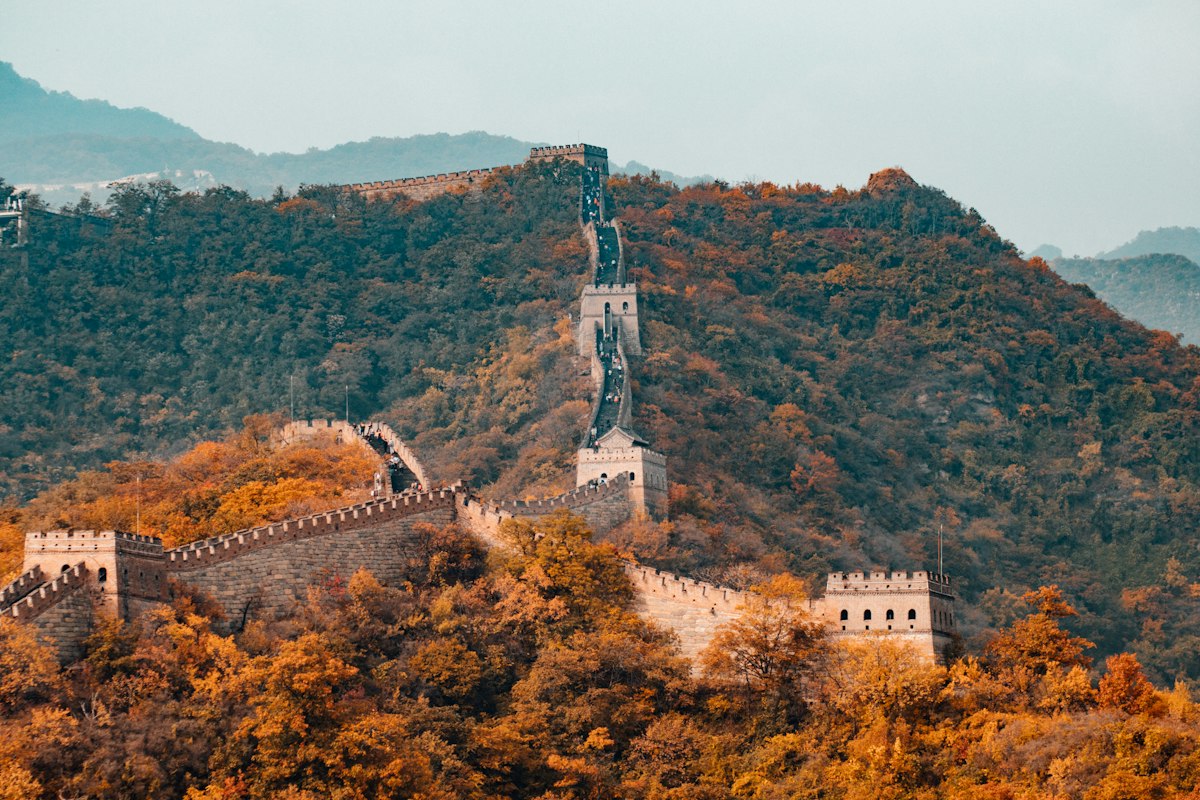
Morning. Leave by 7:30 for Mutianyu (about 1.5 hours by car, or a direct tourist bus from Dongzhimen). Entry is about ¥40, and the cable car about ¥120 return. The restored section has 23 watchtowers on a forested ridge.
Afternoon. Walk west towards tower 20 for the steepest, emptiest stretch, then ride the toboggan down (about ¥100 combined with the chairlift up). Back in Beijing by 16:00.
Evening. See the Temple of Heaven park at dusk, when locals dance and play cards under the trees, then eat at the Wangfujing snack lanes.
Avoid Chinese public holidays, especially 1-7 October and the Labour Day week in May, when Mutianyu and the Forbidden City sell out.
Day 3: Summer Palace, then bullet train to Xi'an
Morning. Visit the Summer Palace (about ¥30-60 with the inner sites), the imperial lakeside retreat with the 728-metre painted Long Corridor and Kunming Lake. Allow 2.5 hours.
Afternoon. Take the G-train from Beijing West to Xi'an North (about 4.5-5.5 hours, roughly ¥520-660 in second class). Book on the official 12306 app or a reseller.
Evening. Walk Xi'an's Muslim Quarter behind the Drum Tower for roujiamo (meat in bread, about ¥15-20), biangbiang noodles and lamb skewers.
Arrive at big stations 45 minutes before departure: there are ID and security checks before the gates.
Day 4: Xi'an: the Terracotta Army
Morning. Take a taxi or tourist bus (about 1 hour) to the Terracotta Warriors (about ¥120; book ahead). Start with Pit 1, which holds about 2,000 restored soldiers in battle order, then Pits 2 and 3 and the bronze chariots in the museum.
Afternoon. Return to the city and cycle the City Wall (about ¥54 entry, bikes about ¥45 for 3 hours), a 13.7 km loop on top of the best-preserved Ming wall in China.
Evening. See the Big Wild Goose Pagoda and the fountain show on its north square, then walk the illuminated Tang Paradise area.
Ignore people at the bus station offering cheaper 'tours' to the warriors; take the official tourist bus from the east square of the railway station.
Day 5: Fly to Guilin, on to Yangshuo
Morning. Fly from Xi'an to Guilin (about 2 hours). From the airport or Guilin North station it is about 1-1.5 hours to Yangshuo, a small town among karst peaks.
Afternoon. Rent an e-bike (about ¥50-80 a day) and ride along the Yulong River past rice fields to the Ming-era Yulong Bridge. Bamboo rafts drift downstream (about ¥200-300 per raft for two).
Evening. Eat beer fish, the local river fish cooked in beer and tomato, away from the noisy West Street, then watch the karst silhouettes at dusk.
A high-speed train also links Xi'an to Guilin, but it takes about 10 hours; the flight saves a day.
Day 6: Li River cruise and Xingping
Morning. Cruise the Li River between Yangshuo and Xingping or from Guilin (about ¥200-450 depending on the boat), past the hills printed on the ¥20 banknote.
Afternoon. Walk the old lanes of Xingping, then climb Laozhai Hill (about 30 minutes of steps) for the river bend at sunset, or hike part of the riverside trail.
Evening. Back in Yangshuo for the Impression Liu Sanjie light show on the river (about ¥200-300), directed by Zhang Yimou, or a quiet guesthouse dinner.
Book the Li River cruise a few days ahead in summer and October; the Guilin-Yangshuo boats are the longest and most expensive.
Day 7: Fly to Shanghai: the Bund and Nanjing Road
Morning. Fly Guilin to Shanghai (about 2.5 hours). From Pudong airport the Maglev reaches 300 km/h to Longyang Road in 8 minutes (about ¥50), then the metro.
Afternoon. Walk Nanjing Road to The Bund, the riverside promenade of 1920s banks and hotels. Cross by ferry (¥2) or metro to Pudong.
Evening. Go up the Shanghai Tower (about ¥180) for the 118th-floor view, then return to the Bund when the Pudong skyline lights up until about 22:00.
The best free view of the skyline is from the Bund at dusk; rooftop bars on the west side charge for a drink.
Day 8: Shanghai: Yu Garden and the French Concession
Morning. Visit Yu Garden (about ¥40) early, before the crowds in the old town bazaar, and eat xiaolongbao soup dumplings at the Nanxiang bun shop next door.
Afternoon. Wander the plane-tree streets of the former French Concession: Wukang Road, the Tianzifang lanes and the shikumen houses of Xintiandi.
Evening. Dinner of Shanghainese hongshao rou (red-braised pork), then jazz at the Fairmont Peace Hotel on the Bund.
Metro tickets can be paid by Alipay QR code at the gates, which saves queueing at the machines.
Day 9: Water town day trip, then home
Morning. Take a bullet train or tour to a canal town: Zhujiajiao (about 1 hour by metro line 17), or the larger Suzhou (25-30 minutes by train) for the classical Humble Administrator's Garden (about ¥70-80).
Afternoon. Return to Shanghai and head to Pudong (about 1 hour by Maglev and metro) or Hongqiao airport (much closer) for the flight home.
Evening. If you have a late flight, a last walk along the Bund or dinner on Huanghe Road, known for its dumpling shops.
Allow 3 hours at Pudong for an international departure, including security and immigration.
Only have 7 days?
With 7 days, skip Yangshuo and take the bullet train Xi'an-Shanghai (about 6 hours) or fly. You keep the four great sights but lose the countryside.
Got extra days?
With 2-3 more days, add Chengdu for the giant pandas and Sichuan food (about 3 hours by train from Xi'an), or Zhangjiajie, the sandstone pillars of Avatar fame, or Hangzhou's West Lake, 1 hour from Shanghai.
Where to stay in China
| Budget | Area | Why | Typical double/night |
|---|---|---|---|
| Budget | Beijing hutong hostels / Yangshuo guesthouses | Courtyard hostels near Shichahai; family guesthouses in the Yangshuo countryside. | ¥200-400 |
| Mid-range | Wangfujing (Beijing) / inside Xi'an City Wall | Walk or one metro ride to the main sights, international-friendly hotels. | ¥500-900 |
| Mid-range | People's Square / Jing'an (Shanghai) | Central metro hub, close to the Bund and the French Concession. | ¥600-1,100 |
| Comfort | The Bund / Pudong, Beijing courtyard hotels | River-view luxury hotels, or restored siheyuan courtyards in the hutongs. | ¥1,500-4,000 |
Getting around
Long distances are by high-speed train (G and D trains), booked on the 12306 app with your passport and boarded with the passport itself. Fares are about ¥0.45 per km in second class. Domestic flights fill the gaps (Xi'an-Guilin, Guilin-Shanghai). City metros are excellent and cost ¥3-8 a ride; DiDi (ride-hailing) works in English and links to Alipay. Many Western apps and Google services are blocked: install a working map app (Apple Maps works; Amap or Baidu are local) and get an eSIM or roaming plan before arrival.
What to eat in China
Chinese food changes completely by region. In Beijing, Peking duck and zhajiangmian noodles; in Xi'an, roujiamo, liangpi (cold noodles) and yangrou paomo (lamb soup with torn bread); around Guilin, Guilin rice noodles for about ¥10-15 a bowl; in Shanghai, xiaolongbao and shengjian bao (pan-fried buns). Simple restaurant meals cost ¥30-60; a full dinner in a good place ¥150-300 per person. Order with picture menus or the translate function of your phone camera. Tap water is not drinkable; bottled water costs about ¥2-3.
Best time to visit
April to May and September to October, with highs of 18-28°C in most of the route. Summer is hot and humid (30-38°C) and brings rain to Guilin; winter is dry and freezing in Beijing (around -5 to 3°C) but quiet. Avoid the Golden Week of 1-7 October and Chinese New Year (late January or February), when trains and sights are full.
Month-by-month weather for China →
What a day costs
| Budget | Mid-range | Comfort | |
|---|---|---|---|
| Bed (per person, sharing a double) | ¥150 | ¥350 | ¥1,000 |
| Food & drink | ¥100 | ¥220 | ¥500 |
| Sights & tickets | ¥80 | ¥150 | ¥300 |
| Local transport | ¥20 | ¥60 | ¥200 |
| Total per person, per day | about ¥350 | about ¥780 | about ¥2,000 |
Approximate 2026 prices in Chinese yuan (about ¥7.2 to the US dollar); high-speed trains and domestic flights, roughly ¥2,500-3,500 per person for this route, are extra.
Before you go
Common questions
Do I need a visa for China?
China has widened visa-free entry: citizens of many European countries, Australia and New Zealand can currently stay up to 30 days without a visa, and many nationalities, including US and UK citizens, can use the 240-hour visa-free transit if flying onward to a third country. The rules change often, so check the Chinese embassy website before booking.
How do I pay in China?
Almost everything is paid by phone. Download Alipay or WeChat, link a foreign Visa or Mastercard before you go, and you can pay street stalls, metros and taxis by QR code. Small fees apply above about ¥200 per transaction. Carry some cash as backup; foreign cards work at major hotels and Bank of China ATMs.
Can I use Google, WhatsApp and Instagram?
Not on Chinese networks: Google services, WhatsApp, Instagram and many Western news sites are blocked. Many travellers buy an international eSIM or use home roaming, which routes data abroad and usually avoids the blocks. Download offline maps and translation packs before you land, and install WeChat to message hotels and guides.
Is 9 days enough for a first trip to China?
It is enough for the classic route if you travel efficiently: three nights in Beijing, two in Xi'an, two in Yangshuo and two in Shanghai. Every move takes most of a morning, so do not add more stops. Two weeks lets you add Chengdu or Hangzhou and slow down in Beijing.
How this guide was made
Compiled by TonyPlan from official tourism, transport and attraction sources and on-the-ground travel knowledge. Prices are approximate for 2026 and change with season; anything we could not confirm is marked as approximate.
Some links on this page are partner links. If you book through them TonyPlan may earn a commission; the price you pay is the same. How we make money.